a story from The Windswept Shores of Troy
The Long Way Home
The long quarrel is over, and it ended not with spears but with friendship. The great gates of Troy stand open, and now it is time to sail home across the...
Reading level
Same story, gentler or richer words.
The Windswept Shores of Troy
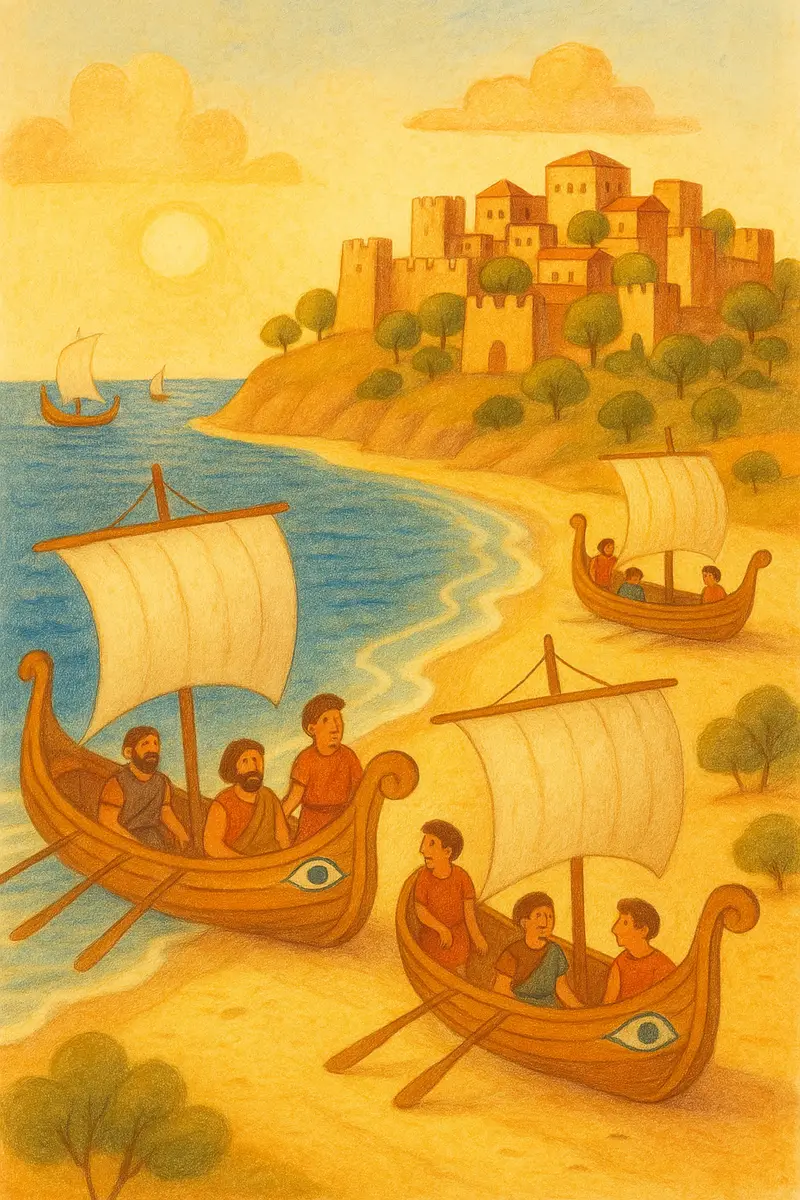
The windswept shores of Troy stretch along a bright Aegean sea, where wooden ships with painted eyes lie beached on the long sand and a great city of honey-coloured walls stands proud on the hill above. For a long while two camps, the weary seafarers on the beach and the proud city behind its gates, have been caught in a tired old quarrel that neither truly wants. Across the wine-dark sea lies the long road home, full of wonders: a loyal old hound, a keeper of the winds, and lonely sea-singers on the rocks. Here a hero is not the strongest or the loudest, but the one who is brave, loyal, and full of ideas. The grandest deeds are done not with spears but with a good idea and a kind heart, and the oldest quarrels often end with a single brave act of friendship.
Read aloud, slowly and warmly. Stop often to let the children answer. There are no wrong answers here, only brave new ideas to try.
Read aloud, or let an older child read it themselves. Pause at each question so the heroes can decide together. There are no wrong answers here, only braver ideas to try.
Before you begin
The long quarrel is over, and it ended not with spears but with friendship. The great gates of Troy stand open, and now it is time to sail home across the Wine-Dark Sea. Far away waits the Weaving Hall, where a warm fire, a homecoming feast, and old friends are ready for you.
Odysseus the Bright walks you down to the ships on the long sandy beach. "It is a long way home," he says, "and the sea is wide. But you are full of ideas, you are brave, and you keep faith with your friends. That is all a sailor truly needs."
He gives you three gifts for the journey: a great spiral Conch Horn, a Basket of Honey and Figs, and a ball of strong thread, Penelope's Thread. Then he smiles. "Out there we do not win by being the strongest. We win by being brave, loyal, and full of ideas."
What is your hero name? Are you a hero of Imagination, of Courage, or of Loyalty?
The long quarrel was over at last, and it had ended in the most surprising way of all: not with spears or fire, but with friendship. The great honey-coloured gates of Troy stood open in the morning sun, and the two old camps shared their bread like neighbours. Now only one journey remained, the longest of them all. It was time to sail home across the Wine-Dark Sea, all the way back to the Weaving Hall, where a warm fire, a homecoming feast, and old friends had been waiting through all the long years away.
Odysseus the Bright walked the two of you down to where the ships lay beached on the long sand. "It is a long way home," he said, looking out at the wide and restless water, "and the sea keeps its own counsel. But you are full of ideas, you are brave, and you keep faith with your friends, and that is worth more on a voyage than a hold full of treasure."
Into your hands he pressed three gifts for the road: a great spiral Conch Horn that sounded a warm, calling note across the water; a Basket of Honey and Figs to share with any wary stranger; and a ball of strong weaving thread, Penelope's Thread, which always leads a traveller home. "Remember," he said, "out on the wide sea we do not win by being the strongest. We win by being brave, by keeping faith, and by being full of ideas."
What is your hero name? Which quality will you carry on the voyage: Imagination, Courage, or Loyalty?
For the grown-up Setup, the rules, and the answers. Open it when you are ready (it has spoilers).
The Long Way Home: Rules for the Grown-Up
The Guide for the Grown-Up explains how the game works; read it once and you are set. This page holds only what is special about this story. A failed roll is never a defeat; nobody loses. This is a braver tale than some, with a wide sea and a long voyage and the pull of a lonely song, but good ideas and kindness still win every time, and no one is ever truly hurt.
Setting up
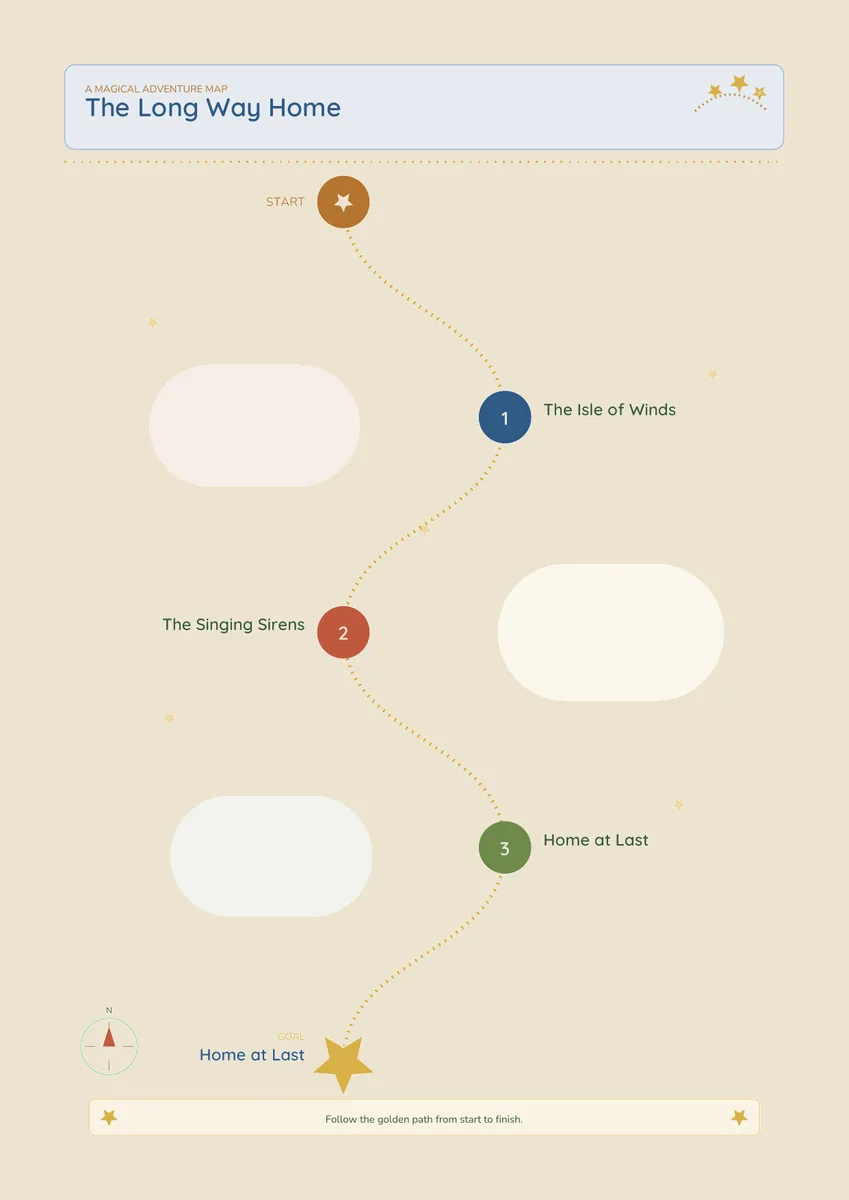
- Print the map. Each player puts a small figure on the Start, the Ship Camp on the shores of Troy.
- This world has no magic. Instead each hero leans on one or two of the five qualities: Imagination (dreaming up ideas), Courage (a steady heart on a wide sea), Loyalty (keeping faith with a friend), Cleverness (a clever, kind idea), or Patience (waiting and trying again). On the hero sheet, where it says magic, let each child write the quality they like best. Two different qualities work best together.
- Give each player five energy stars (five small tokens or bricks). They are spent and refilled during play.
- Set out three props if you can: any spiral shell or cup for the Conch Horn, a small basket or token for the Basket of Honey and Figs, and a ball of string for Penelope's Thread. Anything can be anything.
- Keep your dice and the dice-band table from the back of the kit beside you.
The Twist of Fate
Once at each place the players may roll for a twist; read the matching line. The Guide explains how it works.
| Roll | Twist of Fate |
|---|---|
| 1 | Odysseus the Bright gives you one free hint. |
| 2 | You find your sea-legs again, and take back one energy star. |
| 3 | A fair wind fills the sail, and the next challenge is Easy. |
| 4 | Argos the Faithful Hound trots up and wags his tail. All is well. |
| 5 | A basket of figs for luck: keep one roll to use again later. |
| 6 | A warm sea breeze, and for a moment everyone feels brave. |
How it ends
The Singing Sirens by the rocks are the "obstacle" of the voyage, but they are no villains. They are sea-singers who have been lonely too long, and their sad song pulls ships off course only because no one has ever stopped to befriend them. The tale is won not by fleeing them and not by any kind of force, but by answering their loneliness with kindness: a song sung back, the Conch Horn sounded, the Basket of Honey and Figs shared. Once the Sirens are cheered and befriended, they sing the heroes safely on their way. Let the kindness land; it is the whole point. The last stop is the gentle joy of coming home to the Weaving Hall. See the puzzles page for the three challenges and their solutions.
Stop 1: The Isle of Winds
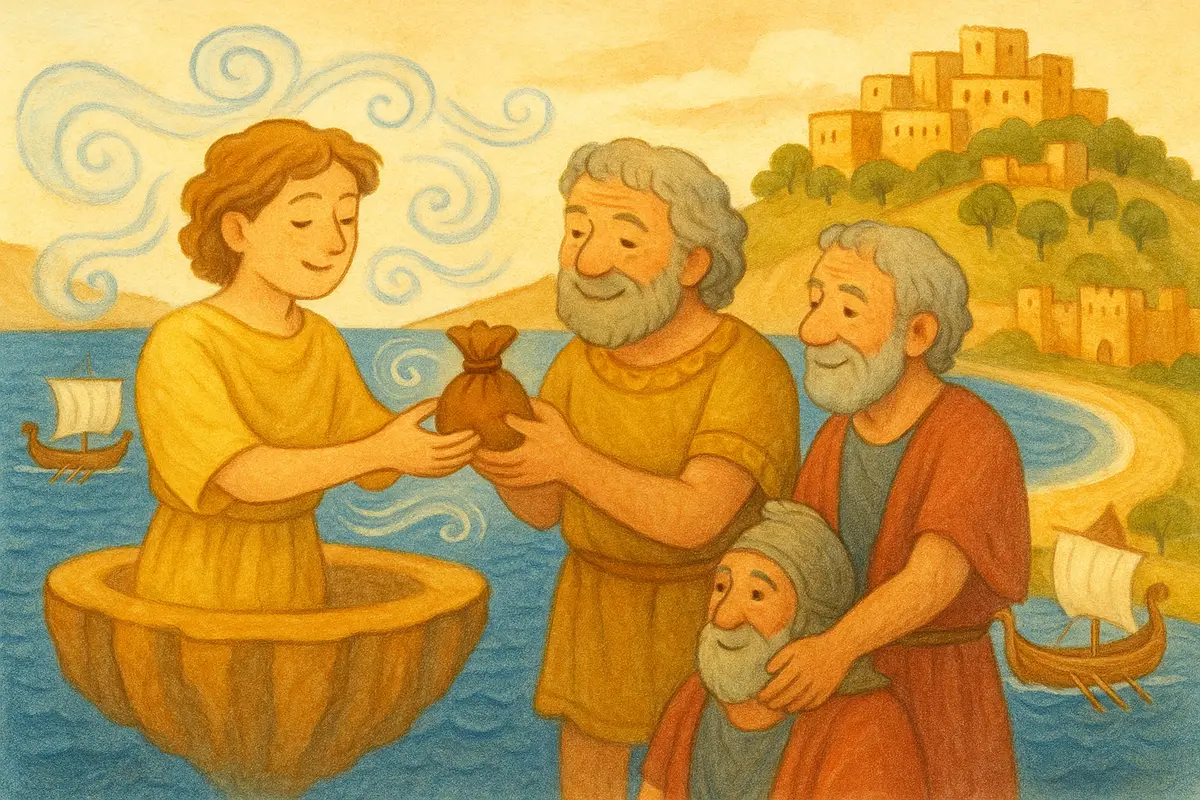
You sail for many days until you come to a floating island ringed with shining bronze cliffs. This is the Isle of Winds, where Aeolus, Keeper of the Winds, lives. He keeps all the winds of the world tied up safe in a great leather bag.
Aeolus is kind, but he is careful. He will only lend a fair wind to travellers who ask with a good idea and politely, and who are not greedy. "Ask me nicely," he says, "and never, ever peek inside the wind-bag."
How will you ask for a fair wind? Could you think of good, kind words to say? Could you promise not to peek inside the bag? What do you try?
When you ask with a good idea and kindly, Aeolus laughs and ties a gentle wind into your sail. "A fair wind for friends," he says, and waves you off across the water.
You sailed for many days, until one bright morning a strange island rose from the sea ahead, ringed all around with cliffs of shining bronze that floated upon the water as lightly as a cork. This was the Isle of Winds, the home of Aeolus, Keeper of the Winds, who kept every gust and gale of the whole world tied up safely inside a great leather wind-bag.
Aeolus met you with a friendly face, but he was a careful host. He would lend a fair wind, he explained, only to travellers who asked him with a good idea and courteously, and who were not greedy enough to go peeking after more than they needed. "Ask me well," he said, with a twinkle, "and give me your word you will never untie the wind-bag to peep inside it. The wind is a gift, not a treasure to be hoarded."
How will you ask Aeolus for a fair wind? Can you find good, courteous words, and perhaps a promise that you will not peek inside the bag? What is your plan?
When you asked him with a good idea and kindly, and gave your word, Aeolus threw back his head and laughed with delight. He gathered a gentle westerly wind in his hands and tied it softly into your sail. "A fair wind for friends who know how to ask," he said, and the bronze cliffs sank away behind you as your ship leapt forward over the waves.
For the grown-up: the solution
The challenge. Aeolus, Keeper of the Winds, will lend a fair wind only to travellers who ask him with a good idea and courteously, and who are not greedy enough to peek inside his wind-bag. The players must win his help with good manners and a good, honest request.
The riddle. If your heroes enjoy a puzzle, let Aeolus set one before he agrees: "I have no hands, yet I fill a sail. I have no voice, yet I make the whole sea wail. You cannot see me, catch me, or keep me in a sack for long. What am I?" The answer is the wind itself.
Intended solution. This is a challenge of Imagination and Courage. The bright, courteous move is to ask Aeolus plainly and politely for just a fair wind home, to thank him, and to promise faithfully not to untie the wind-bag to peek inside. Solving his little wind riddle works just as well. Reward good manners, an honest request, and any promise not to be greedy.
Fallback. If the children are stuck, have Aeolus give them a warm hint ("A kind word and a promise are all I ask, young sailors") or let them spend an energy star to find the right words together. A request made bravely and politely always earns the fair wind.
Make it simpler. Ask a little one to say "please" and blow a big puff of breath like the wind, and Aeolus happily sends them on their way.
Stop 2: The Singing Sirens
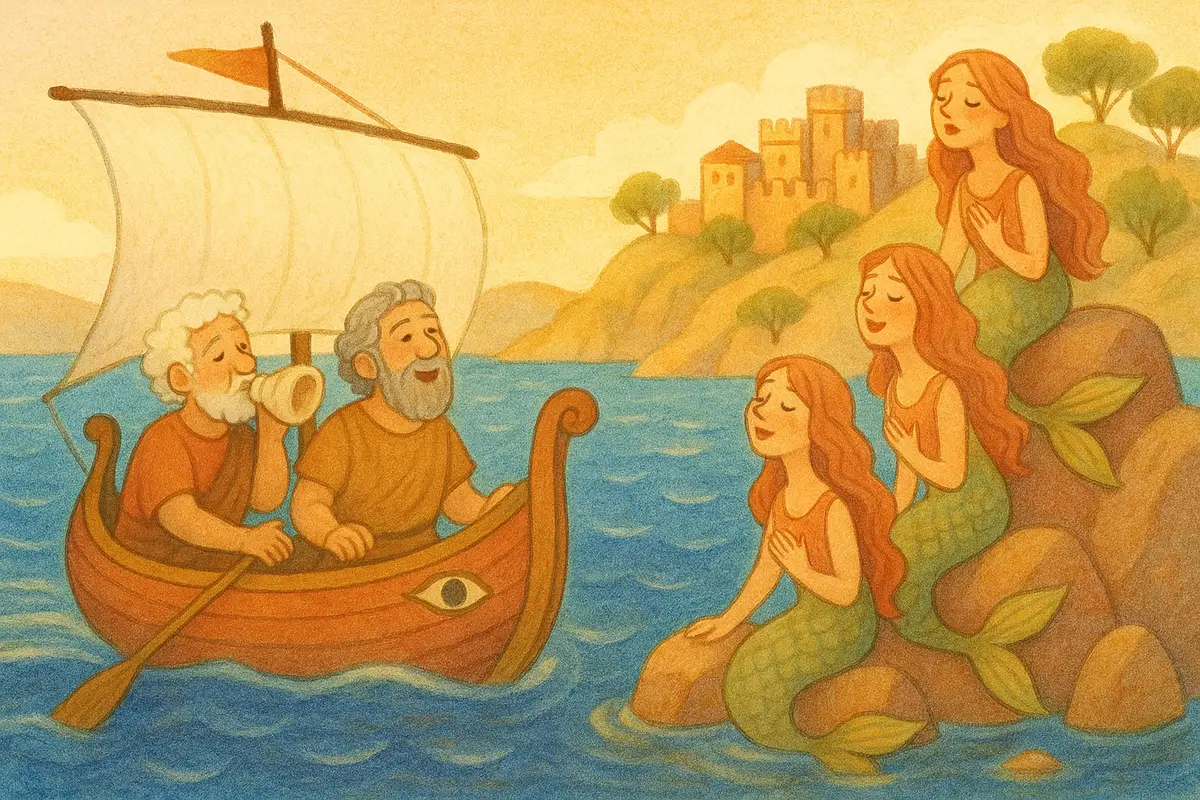
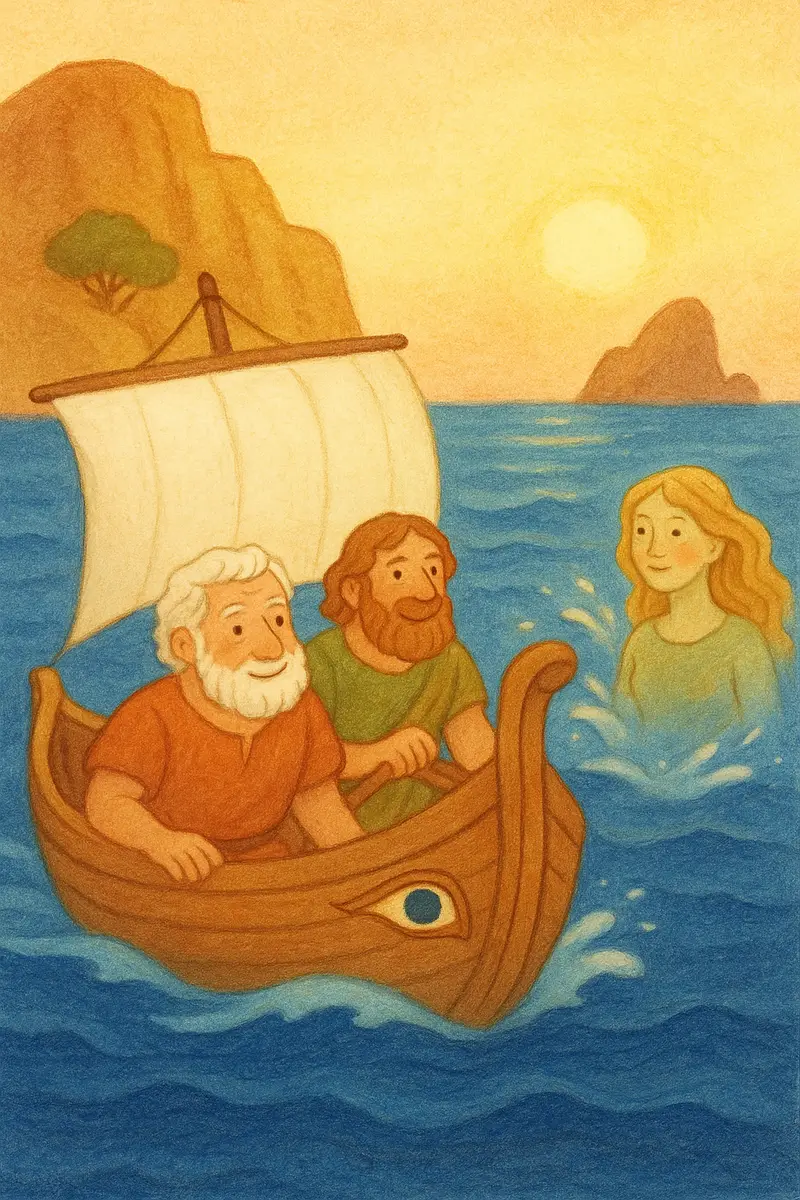
For a long while you sail on. Then you hear it: a song floating over the sea, beautiful and so very sad. It comes from the Singing Sirens, sea-singers who sit on the lonely rocks. Their song is so lonely that ships drift off course just to follow it.
This is not a danger to run from. Listen closely. The Sirens are not wicked at all. They are only lonely, because nobody ever stays to be their friend.
This is not a fight, and it is not a race to escape. What kind thing could you do? You could sing a song back to them. You could sound the Conch Horn. You could share your Basket of Honey and Figs. What do you try?
When you answer their loneliness with kindness, the Sirens stop their sad song. They laugh, they wave, and they begin to sing a bright and happy tune that guides your ship safely past the rocks. "Come back and visit us!" they call.
For many quiet days you sailed on, with Aeolus's wind steady at your back. Then, one still afternoon, you heard it drift across the water: a song. It was the most beautiful thing you had ever heard, and also the saddest, a melody so full of longing that it seemed to tug at the very rudder of your ship. It came from the Singing Sirens, the sea-singers who sat upon a circle of lonely rocks, and ship after ship had drifted off course down the years just to follow that aching tune.
But this was no danger to flee from, though your heart might race to hear it. Listen closely. There was no wickedness in that song at all. The Sirens were only lonely, terribly lonely, for in all their long years not one single sailor had ever stopped to be their friend.
This was never a fight, and it was never a race to slip away unseen. What kindness could you offer the Sirens instead? You might sing a warm song back to them across the water. You might sound the Conch Horn so its kindly note reached their rocks. You might share your Basket of Honey and Figs. What do you try?
When you answered their loneliness with kindness, the saddest song in all the sea faltered and changed. The Sirens lifted their heads in wonder, and then they laughed, a sound that had not been heard on those rocks for a hundred years. They sang again, but now their song was bright and glad, and it wound around your ship like a friendly hand and guided you safely through the rocks. "Come back and visit us one day!" they called after you, waving until the rocks were small behind you.
For the grown-up: the solution
The challenge. The Singing Sirens sit on the lonely rocks, and their song is so sad and so lovely that it pulls ships off course. The players may feel this is a danger to flee, or even to fight. It is neither.
Intended solution. This is a moment of Loyalty (kindness) and Courage. The Sirens are not wicked, only lonely; no one has ever stayed to be their friend. Any genuine kindness works: singing a warm song back to them, sounding the Conch Horn so its friendly note reaches the rocks, sharing the Basket of Honey and Figs, or simply calling out a kind hello. When the children answer the loneliness with kindness, the Sirens cheer up, and their bright new song guides the ship safely past the rocks. There is no roll to escape; the kindness is the answer.
Fallback. If the children freeze, or want to "win" by rowing away as fast as they can, have one Siren call across the water, very softly, "Will nobody ever stop and sing with us?" A single kind word or note from the Conch Horn turns the sad song glad and the Sirens become friends at once.
Make it simpler. Let a little one hum a happy "la-la-la" back to the Sirens, and that cheerful tune is all it takes to make them smile.
Stop 3: Home at Last
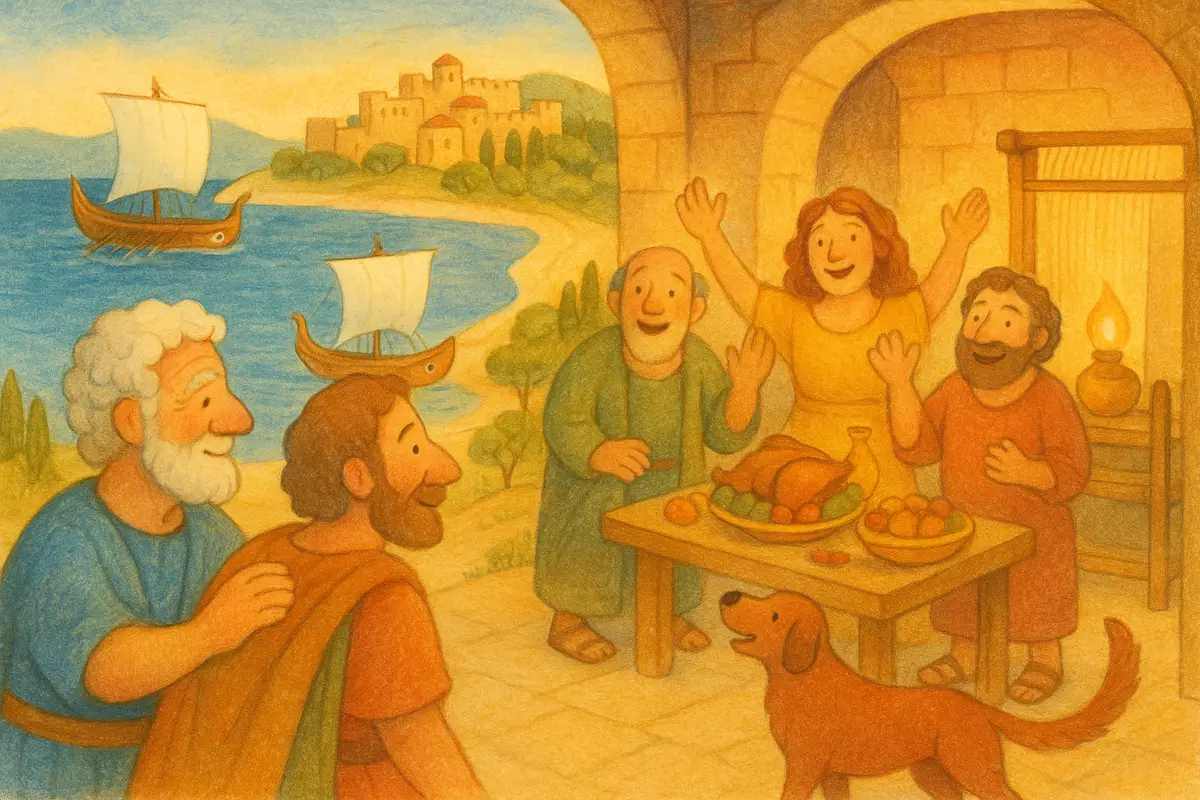
At last, far ahead, you see a shore you know. Your heart beats fast. Is this really home? You must look closely and be sure.
You step onto the sand and find the path up to the Weaving Hall. There, through the door, you can see the great loom where a friend has been weaving while you were away. An old friend looks up. And there, by the fire, an old dog lifts his grey head and sniffs the air.
How will you know you are truly home? What do you remember about this place? Look for the loom, for an old friend, for the faithful hound. Who waits by the fire?
It is Argos the Faithful Hound! He has never forgotten you. He trots up, his tail wagging so hard it nearly knocks him over, and you are home at last.
At last, far across the bright water, a low green shore came into view, and something in you went very still and very sure. Was this truly home, after all this time? You leaned over the rail and looked, and looked again, for you had to be certain.
The ship slid up onto a sand you half remembered, and you followed a winding path up from the shore until the Weaving Hall stood before you, just as it always had. Through the open door you could see the great loom standing in the firelight, with a half-finished weaving on it, as though someone had been working there patiently all the while you were gone. An old friend glanced up from beside the loom. And there, curled by the hearth, a grey old dog raised his head and tested the air with his nose.
How will you know, truly know, that you are home? What do you remember of this place? Look for the great loom, for the face of an old friend, for the faithful hound by the fire. Who is it that waits there?
It was Argos the Faithful Hound, who never in all his long life had forgotten a friend or a scent. For a moment he simply stared. Then he scrambled up on his stiff old legs and trotted to you, his tail wagging so hard that the whole of him wagged with it, and you knew, past all doubt, that you were home at last.
For the grown-up: the solution
The challenge. The heroes reach a green shore that may be home. They must cross the last stretch and be sure, then recognise the Weaving Hall and the friends waiting inside.
Intended solution. This is a moment of Loyalty and Observation. The bright and loyal move is to remember the marks of home: the great loom standing in the firelight, the face of an old friend, and above all Argos the Faithful Hound by the hearth, who knows them at once. Naming what they remember, or calling the old dog's name, settles it beyond doubt and the homecoming begins.
Fallback. If the children are unsure whether this is truly home, let Argos settle it: the old hound lifts his grey head, catches their scent, and trots straight to them with his tail wagging, because he has never once forgotten a friend. Recognising home with the dog's help still counts as a full success and tops up an energy star.
Make it simpler. Ask a little one to call out the dog's name, "Argos!", and give a big happy wave, and the homecoming begins right away.
Home at Last
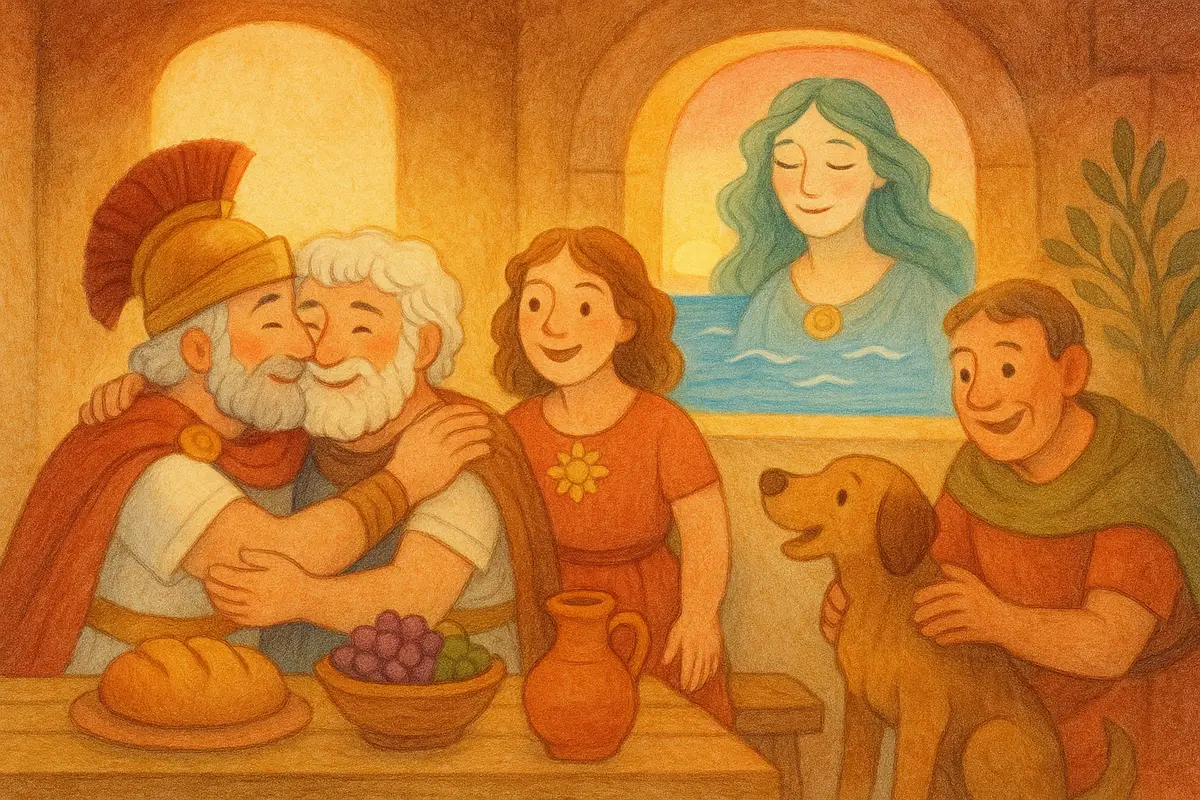
The Weaving Hall is warm and full of light. The homecoming feast is laid out: warm bread, sweet figs, and honey. Old friends hug you and call your hero name. Argos the Faithful Hound will not leave your side.
High above the calm water, Thetis the Sea-Mother smiles down on you. You crossed the whole Wine-Dark Sea and came home together. You were brave, you were full of ideas, and most of all you kept faith with your friends. Well done, heroes. Welcome home.
The Weaving Hall filled with warmth and golden light. The homecoming feast was laid along the long table: fresh bread still warm from the oven, ripe figs, and clear honey. Old friends threw their arms around you and called you by your hero name, hardly able to believe that the long way home was done. And Argos the Faithful Hound would not be parted from your side, not for one single moment.
Far out over the calm and shining sea, Thetis the Sea-Mother looked up from the gentle waves and smiled. You had crossed the whole wide Wine-Dark Sea, from the windswept shores of Troy to your own warm door, and you had done it together: with your courage, with your imagination, and above all by keeping faith with one another. Well done, heroes of the windswept shores. Welcome home.
Here nobody loses. If a try does not work, you just find another way.
Read aloud together, pause often, and try ideas. There are no wrong answers.