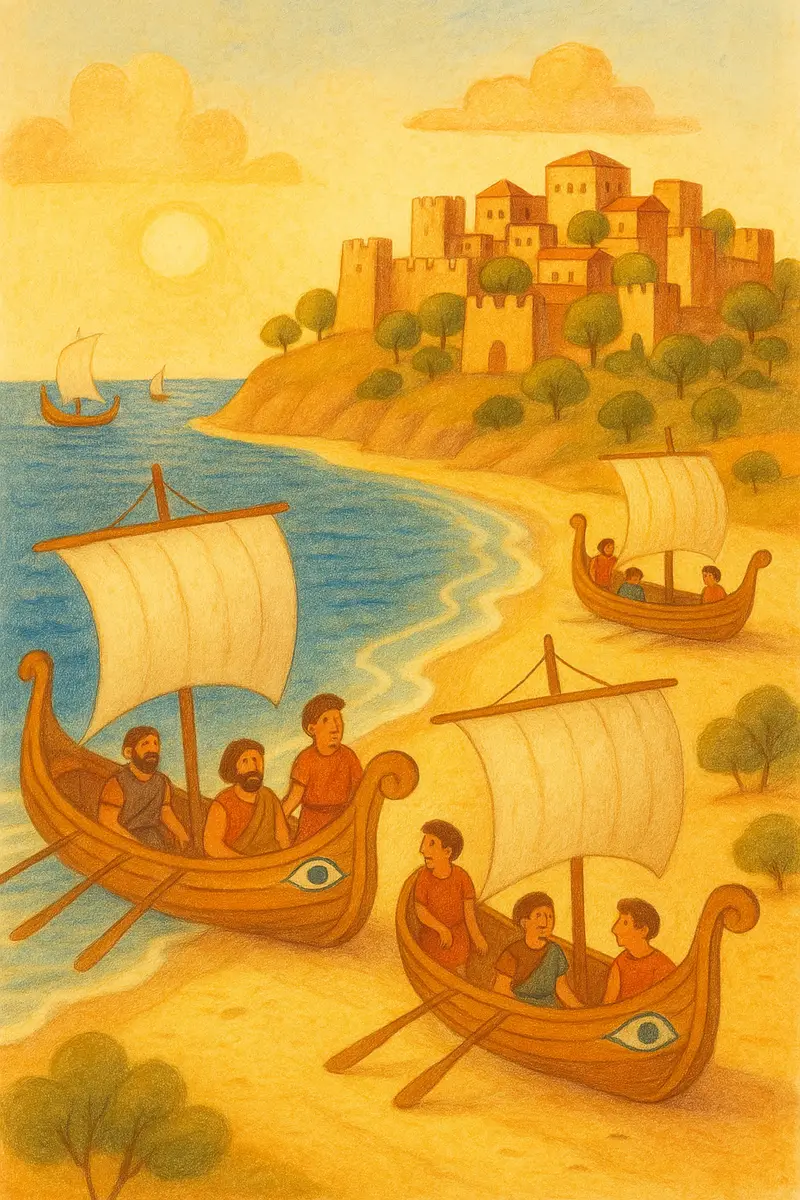
a story from The Windswept Shores of Troy
The Great Wooden Horse
For a long, long time the two camps on the windswept shores of Troy have been cross with each other. The seafarers live in tents and wooden ships along the...
Reading level
Same story, gentler or richer words.
The Windswept Shores of Troy
The windswept shores of Troy stretch along a bright Aegean sea, where wooden ships with painted eyes lie beached on the long sand and a great city of honey-coloured walls stands proud on the hill above. For a long while two camps, the weary seafarers on the beach and the proud city behind its gates, have been caught in a tired old quarrel that neither truly wants. Across the wine-dark sea lies the long road home, full of wonders: a loyal old hound, a keeper of the winds, and lonely sea-singers on the rocks. Here a hero is not the strongest or the loudest, but the one who is brave, loyal, and full of ideas. The grandest deeds are done not with spears but with a good idea and a kind heart, and the oldest quarrels often end with a single brave act of friendship.
Read aloud, slowly and warmly. Stop often to let the children answer. There are no wrong answers here, only brave new ideas to try.
Read aloud, or let an older child read it themselves. Pause at each question so the heroes can decide together. There are no wrong answers here, only braver ideas to try.
Before you begin
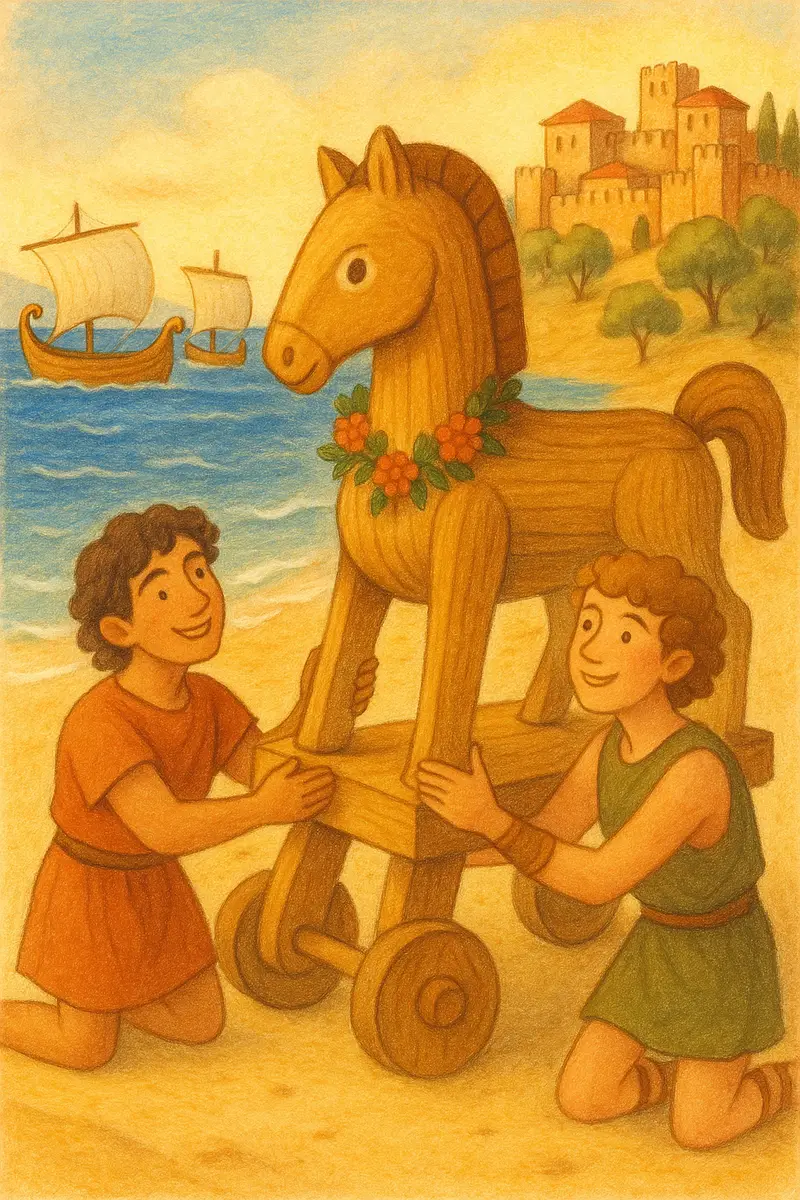
For a long, long time the two camps on the windswept shores of Troy have been cross with each other. The seafarers live in tents and wooden ships along the beach. The proud city sits up on the hill behind great honey-coloured walls, with its gates shut tight. Nobody quite remembers how the quarrel began. The truth is, everyone is rather tired of it, and both camps secretly wish it would just stop.
Odysseus the Bright calls you to him. He has a curly beard and a kind, twinkly smile, and in his hands he holds a tiny wooden horse. "I have a good idea," he says. "Let us build a great wooden horse, as big as a house. But we will not fill it with soldiers. We will fill it with gifts and music and friendship, and roll it to the gates as a happy surprise. That is how we end the quarrel."
He gives you three gifts: a basket of honey and figs, Penelope's thread, and a conch horn. Then he smiles. "On these shores we do not win by being the strongest. We win by being brave, loyal to a friend, and full of ideas."
What is your hero name? Will you carry Imagination, Courage, or Loyalty?
For longer than anyone could properly remember, the two camps on the windswept shores of Troy had been caught in a tired old quarrel. Down on the long beach the seafarers lived among their tents and their wooden ships with painted eyes. Up on the hill the proud city stood behind its great honey-coloured walls, with its gates barred fast. Nobody could say how it had started, and the strange thing was that nobody on either side really wanted it any more. Both camps were weary to the bone, and both, in their secret hearts, longed for it simply to end.
Odysseus the Bright called the two of you to his side. He had a short curly beard and a kind, twinkling smile, and he turned a tiny carved horse over in his hands as he spoke. "I have had an idea," he said, "and it is a better one than any shouting across the sand. Let us build a great wooden horse, as tall as a house. But we shall not fill it with soldiers, as the old, sad stories might. We shall fill it with gifts and music and a hand of friendship, and roll it up to the gates as a happy surprise. A kind surprise can end a quarrel that a thousand cross words never could."
Into your hands he pressed three gifts: a basket of honey and figs, a ball of Penelope's thread, and a great spiral conch horn. "Remember," he said, "on these shores we do not win by being the strongest. We win by being brave, loyal to a friend, and full of ideas."
What is your hero name? Which quality will you carry: Imagination, Courage, or Loyalty?
For the grown-up Setup, the rules, and the answers. Open it when you are ready (it has spoilers).
The Great Wooden Horse: Rules for the Grown-Up
The Guide for the Grown-Up explains how the game works; read it once and you are set. This page holds only what is special about this story. A failed roll is never a defeat; nobody loses. This is a gentle tale with no battle in it at all: the two old camps are simply weary of quarrelling, and the heroes win by ending the quarrel with a kind surprise.
Setting up
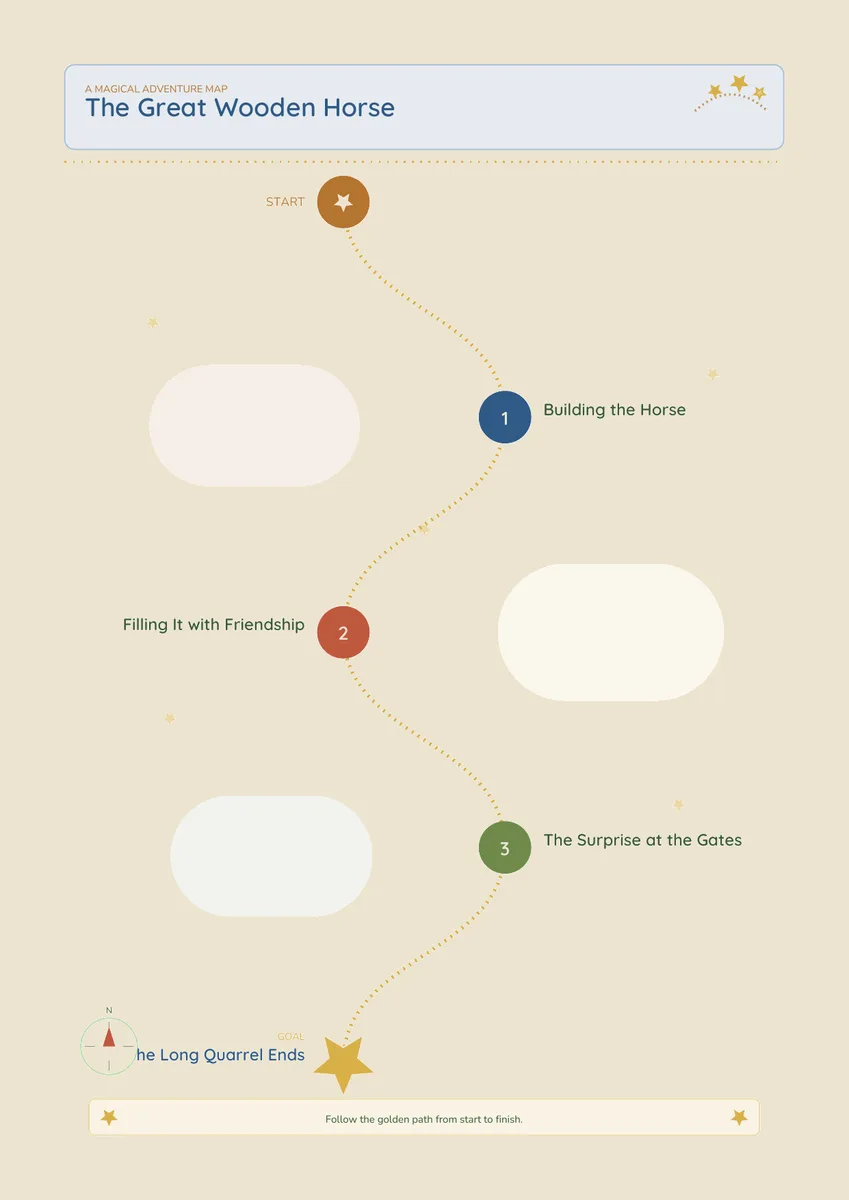
- Print the map. Each player puts a small figure on the Start, the Ship Camp on the beach.
- This world has no magic. Instead each hero leans on one or two of the five qualities: Imagination (dreaming up ideas), Courage (a steady heart), Loyalty (keeping faith with a friend), Cleverness (a clever, kind idea), or Patience (waiting and trying again). On the hero sheet, where it says magic, let each child write the quality they like best. Two different qualities work best together.
- Give each player five energy stars (five small tokens or bricks). They are spent and refilled during play.
- Set out three props if you can: a ball of string for Penelope's thread, a few small treats or tokens for the basket of honey and figs, and any shell or cup for the conch horn. Anything can be anything.
- Keep your dice and the dice-band table from the back of the kit beside you.
The Twist of Fate
Once at each place the players may roll for a twist; read the matching line. The Guide explains how it works.
| Roll | Twist of Fate |
|---|---|
| 1 | Odysseus the Bright gives you one free hint. |
| 2 | You catch your second wind, and take back one energy star. |
| 3 | A fair wind, and the next challenge is Easy. |
| 4 | Argos the Faithful Hound trots up and wags his tail. All is well. |
| 5 | A basket of figs for luck: keep one roll to use again later. |
| 6 | A warm sea breeze, and for a moment everyone feels brave. |
How it ends
The wary city at the gates is the "obstacle", but there is no villain here at all, and not one soldier hides inside the horse. The proud city is simply tired of an old quarrel, just as the seafarers are. The tale is won not by beating anyone but by surprising the weary city with friendship: a warm note on the conch horn, an open door, and a shared basket of figs. Let the kindness land; it is the whole point. See the puzzles page for the three challenges and their solutions.
Stop 1: Building the Horse
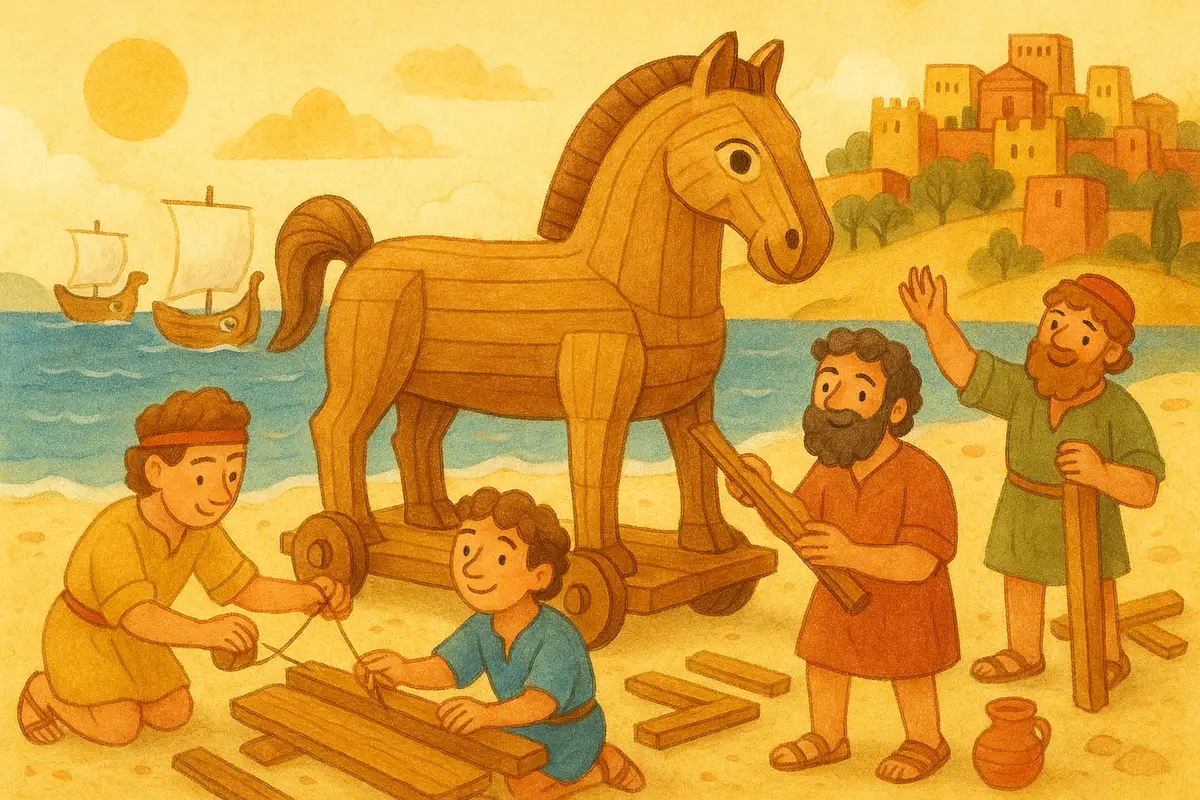
On the beach lie heaps of smooth wooden planks. The horse must be built tall and strong, so it stands up without wobbling, with a little door in its side.
The builders scratch their heads. How many planks for each leg? How do you fit the curved pieces so they balance? Penelope's thread can measure each piece, and careful counting will tell you how many you need.
How could you build it so it stands up straight? Could you measure with the thread? Could you count the planks together? Try something and see.
When you fit the pieces and balance them just right, the great wooden horse rises up on its wheels, tall and proud and steady. Everyone cheers.
The builders had gathered great heaps of smooth wooden planks along the sand, but heaps of wood are not yet a horse. It had to stand tall and strong on its wheels, balanced so it would not wobble or topple, with a neat little door cut into one side.
The carpenters scratched their heads and looked to you. How many planks would each sturdy leg need? How should the curved pieces of the great barrel body be fitted so the whole thing balanced? Penelope's thread was just the tool for measuring a piece before it was cut, and careful counting would tell you exactly how many planks the builders must bring.
How could you build it so it stands straight and steady? Could you measure each piece with the thread? Could you count the planks out together and work out the balance? What is your plan?
When the pieces were measured, counted, and fitted together just so, the great wooden horse rose at last upon its wheels: tall, proud, and steady as the walls themselves. The whole beach broke into a cheer.
For the grown-up: the solution
The challenge. The great wooden horse must be built tall, strong, and steady on its wheels, with a little door in its side. The players help the carpenters work out how the wooden pieces fit and balance, and how many planks the build will need.
Intended solution. This is a moment of Imagination, Logic, and a little Spatial thinking and Maths. The bright move is to use Penelope's thread to measure a piece before it is cut, and to count the planks together so each leg matches and the body balances. Sorting the pieces by shape, or laying out a simple plan before building, works just as well. Settling on any sensible, balanced plan passes the stop.
Fallback. If the children are unsure, have a friendly carpenter hold up two planks and ask, "Which of these is longer, do you think?", or let them spend an energy star to "measure twice and cut once". Counting out loud together always gets there. Any steady plan raises the horse and tops up an energy star.
Make it simpler. For a very young builder, just stack four wooden blocks for the legs and one on top for the body, and cheer the little horse standing up.
Stop 2: Filling It with Friendship
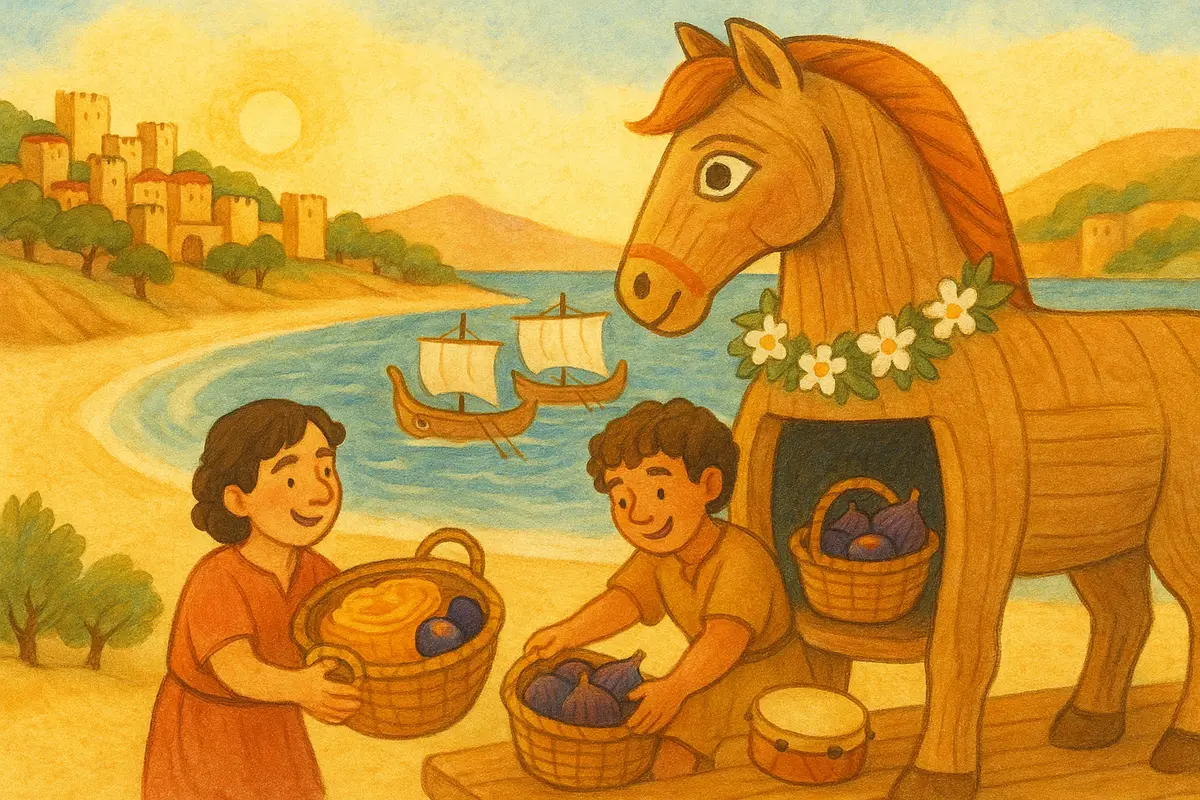
Now the horse is built, and its little door stands open. What should you put inside? Not soldiers, never soldiers. The whole idea is a kind surprise.
You look at all the lovely things on the beach: the basket of figs, garlands of bright flowers, and a little drum for happy music.
What kind things would make the best surprise? Which gifts say "let us be friends"? Choose together. There is no wrong answer here.
When you tuck the figs, the flowers, and the little drum inside, the horse feels warm and welcoming, like a present waiting to be opened. It is the friendliest horse anyone has ever seen.
The horse was built, and its little side door stood open like a question. Now came the heart of Odysseus's idea: what should go inside? Not soldiers, and not anything frightening. The entire point was a gift, a surprise so kind that no shut gate could stay shut against it.
You looked over all the lovely things laid out along the sand: the basket of ripe figs and golden honey, garlands of bright flowers gathered from the hillside, and a small drum for making happy music.
Which things would make the kindest surprise? Which gifts whisper, "let us be friends at last"? Choose them together. There is truly no wrong answer here, only warmer ones.
When you had tucked the figs, the flower garlands, and the little drum safely inside, the great horse seemed to glow with welcome, like a present that can hardly wait to be opened. It was, beyond any doubt, the friendliest horse that the shores of Troy had ever seen.
For the grown-up: the solution
The challenge. The horse is built and its door stands open. The players choose what to put inside. The whole idea is a kind surprise, so the answer is never soldiers and never anything frightening, only friendly things.
Intended solution. This is a gentle Social-emotional and Logic moment. Any warm, welcoming choice works: the basket of honey and figs to share, garlands of bright flowers, and a little drum for happy music. Ask the children which gifts say "let us be friends", and let them explain why. Naming any kind gift, and saying why it is kind, passes the stop.
Fallback. If a child suggests something fierce, gently wonder aloud together, "How would the city folk feel if they opened the door and found that? What would make them smile instead?" Steer warmly towards the figs, the flowers, and the drum. Choosing any kind thing is a full success and tops up an energy star.
Make it simpler. Ask a little one to pick just one nice thing from the room, a soft toy or a snack, and pop it inside the horse to share.
Stop 3: The Surprise at the Gates
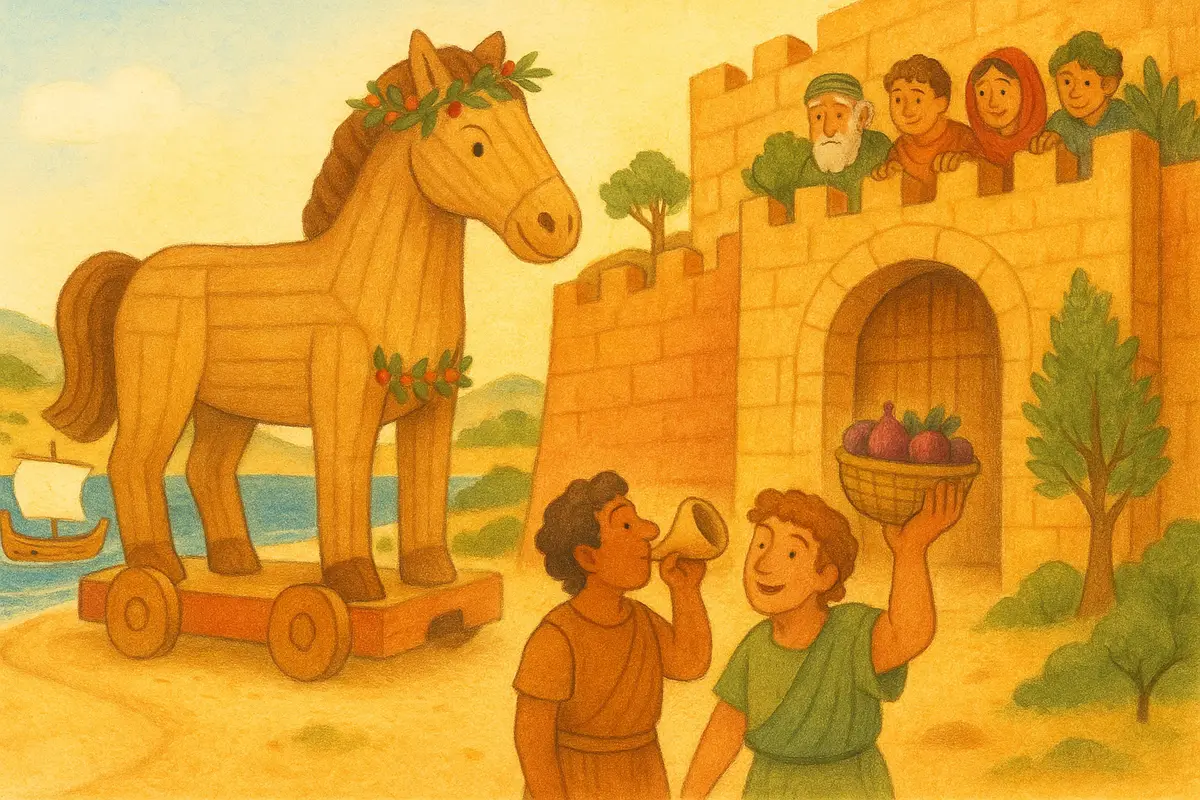
Slowly, slowly, you roll the great horse up the hill to the city gates. The folk on the walls peer down. They look wary and weary. The gates stay shut. For a moment, your heart thumps.
But this is not a fight. It is a gift. You only need to show them it is kind.
What could you do to show them you come as friends? You have the conch horn to sound a warm hello. You could open the horse's door and share the figs. What do you try?
When you sound the conch horn and open the door, out tumble figs and flowers and a merry drumbeat. The watchful folk gasp, then laugh, then beam. Slowly, the great gates creak open at last.
Slowly, and with many willing hands, you rolled the great horse up the long hill to the gates of the city. High on the honey-coloured walls the city folk gathered to watch, wary and weary, and the gates stayed firmly shut. For one long moment your heart thumped in your chest.
But this was never a fight, and the horse was never a trick. It was a gift. All you had to do was show the weary city that it came from friends.
What could you do to show them you come in friendship? You carry the conch horn to sound a warm and welcoming hello across the walls. You could swing open the horse's door and share the sweet figs. What do you try?
When you lifted the conch horn and sounded its warm, round note, and then opened the little door, out spilled figs and flowers and the merry tap of the drum. The watchful faces on the walls froze, then softened, then broke into astonished smiles. With a great groan of old timber, the gates of the proud city swung open at last.
For the grown-up: the solution
The challenge. The heroes roll the horse up to the city gates, which stay shut. The watchful folk on the walls look wary and weary. The players may feel this is a standoff. It is not. It is a gift waiting to be opened.
Intended solution. This is a moment of Courage and Social-emotional warmth. The city is not an enemy, only tired and unsure. Any genuine, friendly gesture works: sounding the conch horn as a warm hello, opening the horse's door, sharing the figs, calling up a kind word, or beating the little drum. When the surprise of friendship lands, the great gates swing open. Showing the city any clear sign of friendship passes the stop.
Fallback. If the children freeze, or imagine the gates will never open, have a single curious child appear at the top of the wall and call down, "Is that... for us?" The smallest kindness, a wave, a fig held up, a soft note on the horn, melts the wariness and the gates begin to open.
Make it simpler. Let a little one simply wave and call out "hello, friends!" to the city, and that warm greeting swings the gates wide.
The Long Quarrel Ends
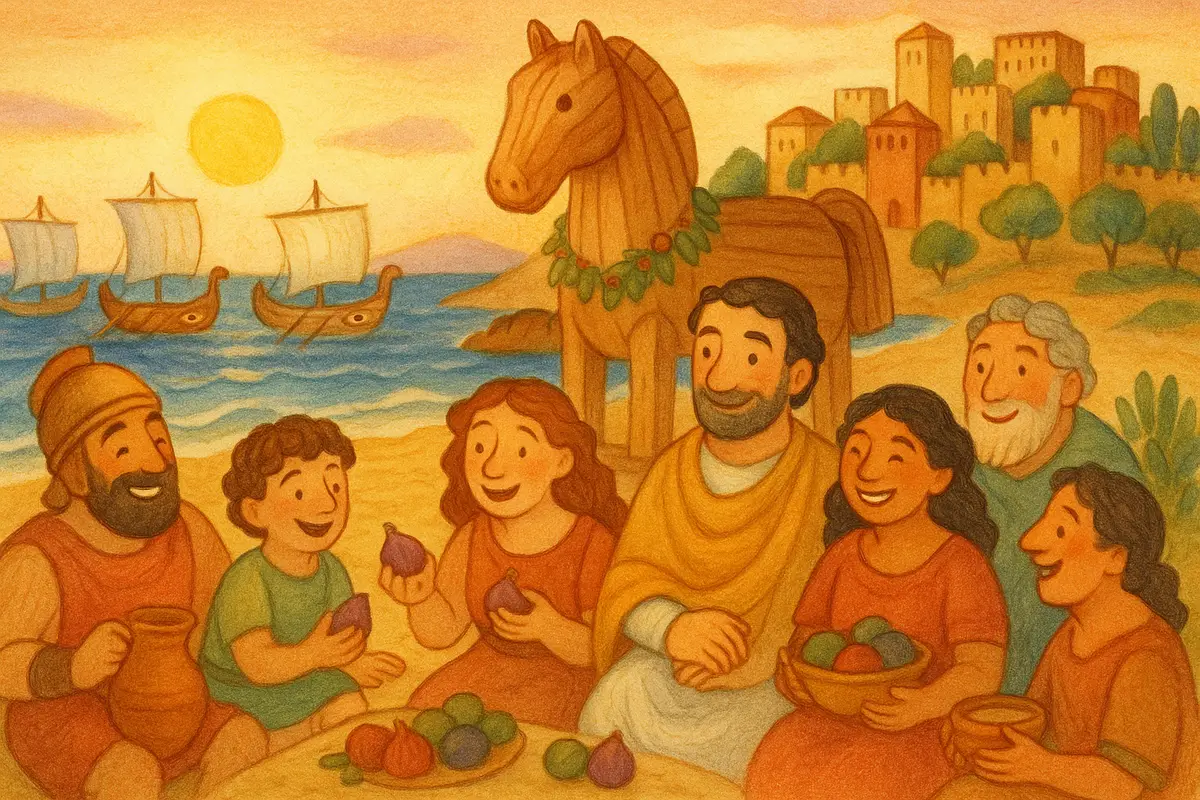
The city folk come down from their walls, and the seafarers come up from the beach, and they meet in the middle, a little shy. Then someone shares a fig. Someone beats the little drum. Someone laughs, and then everyone laughs.
The two camps spread out a great feast together, side by side, as if the quarrel had never been. Out on the calm water, Thetis the Sea-Mother lifts her head from the waves and smiles. You did it together. You were brave, you were loyal, and you were full of ideas, and the oldest quarrel of all has ended with a kind surprise. Well done, heroes of Troy.
Down came the city folk from their high walls, and up came the seafarers from the beach, and they met in the middle of the hill, shy and uncertain at first. Then one hand offered a fig to another. Someone tapped the little drum. Somebody laughed, and the laughter spread until the whole hillside rang with it.
Together, side by side, the two camps spread a great feast upon the grass, as though the long quarrel had been no more than a bad dream now happily forgotten. Far out on the gentle, glittering water, Thetis the Sea-Mother raised her face from the waves and smiled to see it. You had done it, and you had done it together: with your courage, with your loyalty to a friend, and above all with your imagination. The oldest quarrel of all had ended, not with spears, but with a single kind surprise. Well done, heroes of the windswept shores of Troy.
Here nobody loses. If a try does not work, you just find another way.
Read aloud together, pause often, and try ideas. There are no wrong answers.