a story from The Sunlit Hills of Greece
The Singing Spring
The Singing Spring has gone quiet. High in the hills, the water used to sing all day, and its song kept every well in the town full and cool. Now the song...
Reading level
Same story, gentler or richer words.
The Sunlit Hills of Greece
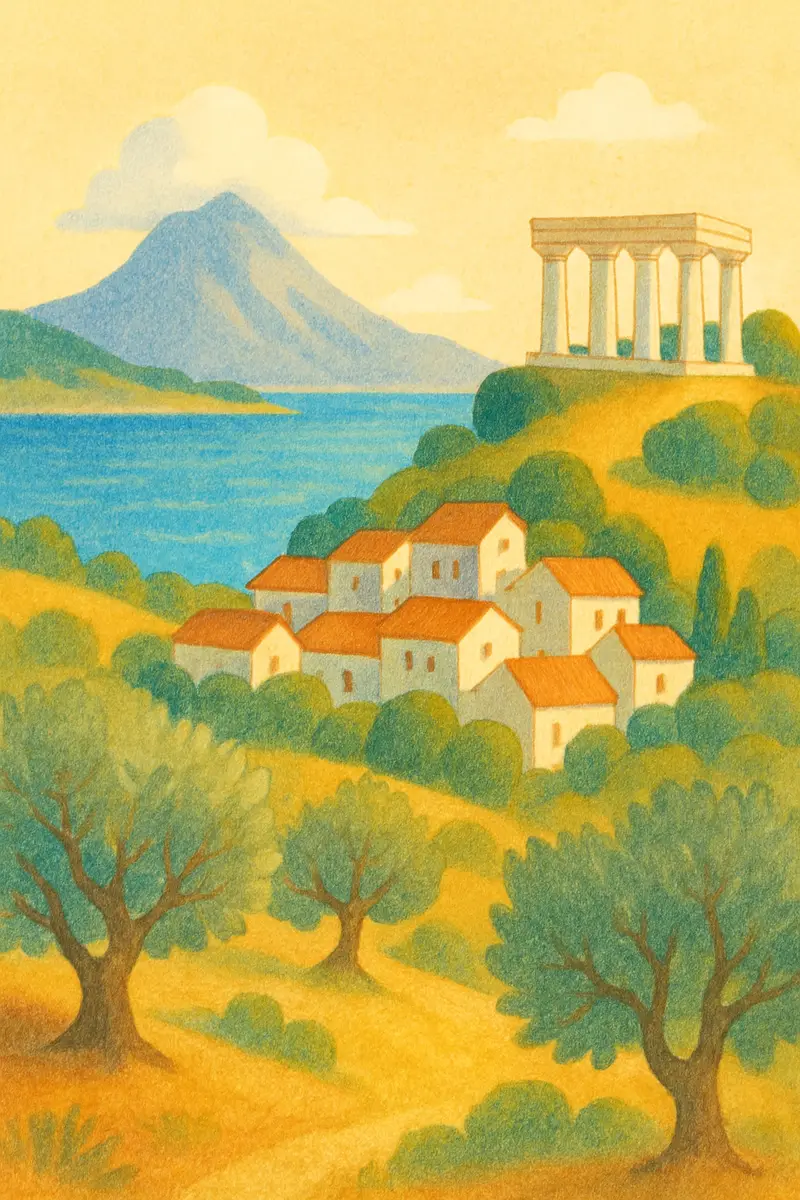
The sunlit hills of Greece roll down to a bright blue sea, dotted with olive groves, white marble columns, and little towns where everyone knows your name. High above, hidden in the clouds of Mount Olympus, the gods watch over the world, and the hills are full of wonders: riddling sphinxes, kindly centaurs, shy satyrs, and nymphs who sing by the springs. Here a hero is not the strongest or the loudest, but the one who keeps a cool head, asks good questions, and stands by a friend. The grandest deeds are done by being brave and kind and full of ideas. Even a fearsome guardian, met with courage and a fair word, often turns out to be lonelier than it is wicked.
Read aloud, slowly and warmly. Stop often to let the children answer. There are no wrong answers here, only brave new ideas to try.
Read aloud, or let an older child read it themselves. Pause at each question so the heroes can decide together. There are no wrong answers here, only braver ideas to try.
Before you begin
The Singing Spring has gone quiet. High in the hills, the water used to sing all day, and its song kept every well in the town full and cool. Now the song has stopped. The wells are low. The olive trees are thirsty.
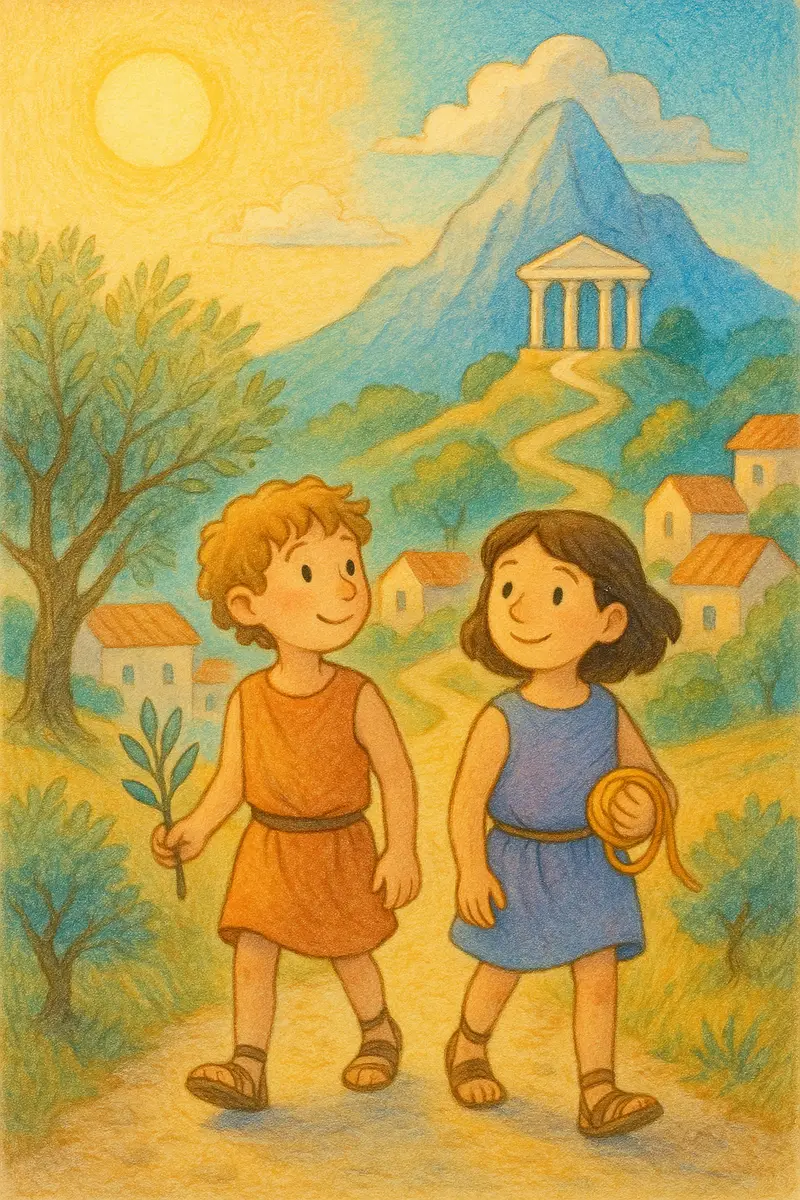
Old Daphne, who keeps the olive grove, calls you to her. "You two have bright ideas and kind hearts," she says. "Will you climb the hill and wake the spring?"
She gives you three gifts: a ball of golden thread, a honey cake, and a little lyre. Then she smiles. "Up here we do not win by being the strongest. We win by being brave, kind, and full of ideas."
What is your hero name? Are you a hero of Imagination, of Courage, or of Heart?
For as long as anyone could remember, the Singing Spring had sung high in the hills, and its song had kept every well in the Olive Town cool and brimming. Then, one grey morning, the song simply stopped. The wells sank low. The olive leaves hung limp and thirsty, and the whole valley felt as if it were holding its breath.
Old Daphne, keeper of the olive grove, called the two of you to her side. "You have bright ideas and kind hearts," she said, "and that is worth more up there than any sword. Will you climb the hill and wake the spring?"
Into your hands she pressed three gifts: a ball of golden thread, a honey cake wrapped in a leaf, and a small lyre worn smooth with playing. "Remember," she said, "in these hills we do not win by being the strongest. We win by being brave, kind, and full of ideas."
What is your hero name? Which quality will you carry: Imagination, Courage, or Heart?
For the grown-up Setup, the rules, and the answers. Open it when you are ready (it has spoilers).
The Singing Spring: Rules for the Grown-Up
New to this? Read the Guide for the Grown-Up first. It explains the whole idea in two pages and you will never need it again.
The Guide for the Grown-Up explains how the game works: this page holds only what is special about this story. It is a braver tale than some, but good ideas and kindness still win every time, and no one is ever truly hurt. A failed roll is never a defeat; nobody loses.
Setting up
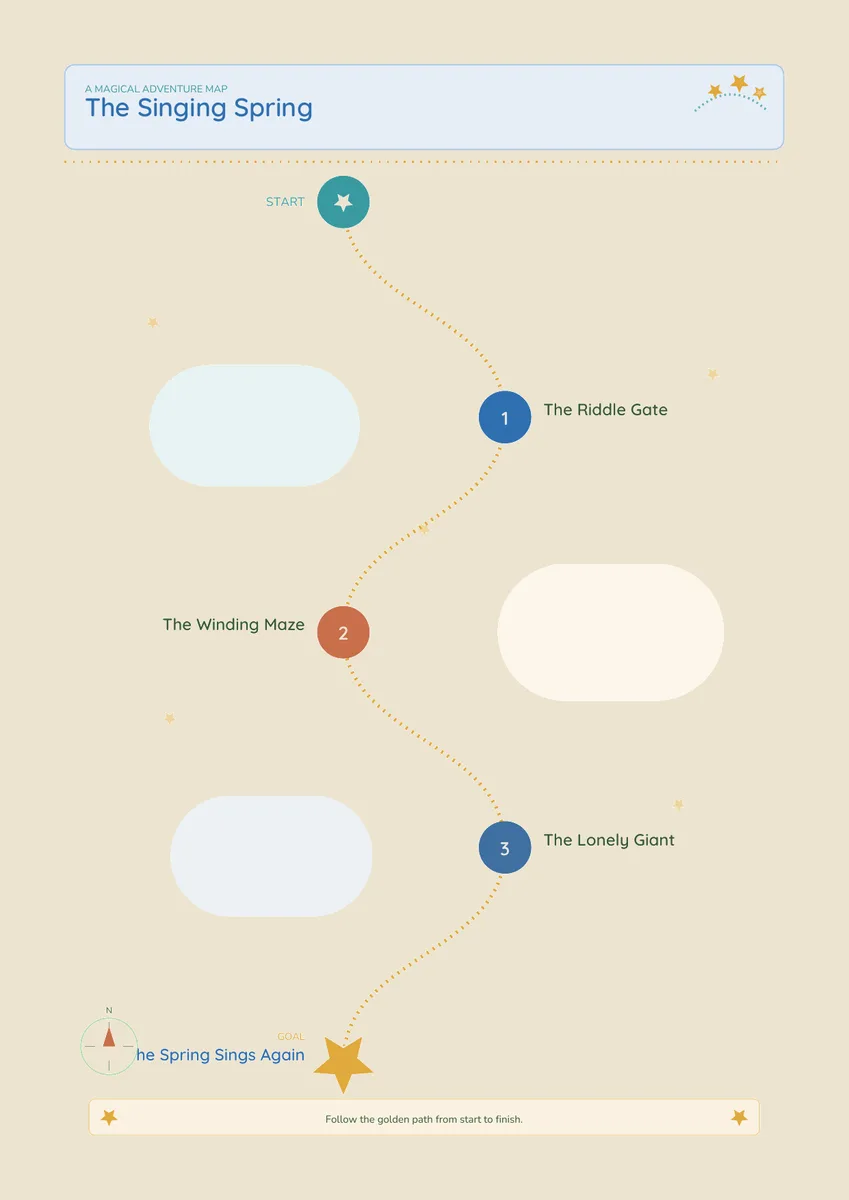
- Print the map. Each player puts a small figure on the Start, the Olive Town.
- This world has no magic. Instead each hero leans on one or two of the five qualities: Imagination (dreaming up ideas), Courage (a steady heart), Heart (caring for others), Curiosity (noticing what others miss), or Cleverness (a clever, kind idea). On the hero sheet, where it says magic, let each child write the quality they like best. Two different qualities work best together.
- Give each player five energy stars (five small tokens or bricks). They are spent and refilled during play.
- Set out three props if you can: a ball of string for the golden thread, a small cake or token for the honey cake, and anything at all for a lyre. Anything can be anything.
- Keep your dice and the dice-band table from the back of the kit beside you.
The Twist of Fate
Once at each place the players may roll for a twist; read the matching line. The Guide explains how it works.
| Roll | Twist of Fate |
|---|---|
| 1 | A friendly satyr gives you one free hint. |
| 2 | You find your courage again, and take back one energy star. |
| 3 | A favourable wind, and the next challenge is Easy. |
| 4 | Chiron the centaur passes by and nods kindly. All is well. |
| 5 | An olive branch for luck: keep one roll to use again later. |
| 6 | A burst of birdsong, and for a moment everyone feels brave. |
How it ends
The Lonely Cyclops at the spring is the "foe", but he is no villain. He is a giant who has been alone too long. The tale is won not by beating him but by befriending him, and then by waking the Singing Nymphs with a tune. Let the kindness land; it is the whole point. See the puzzles page for the three challenges and their solutions.
Stop 1: The Riddle Gate
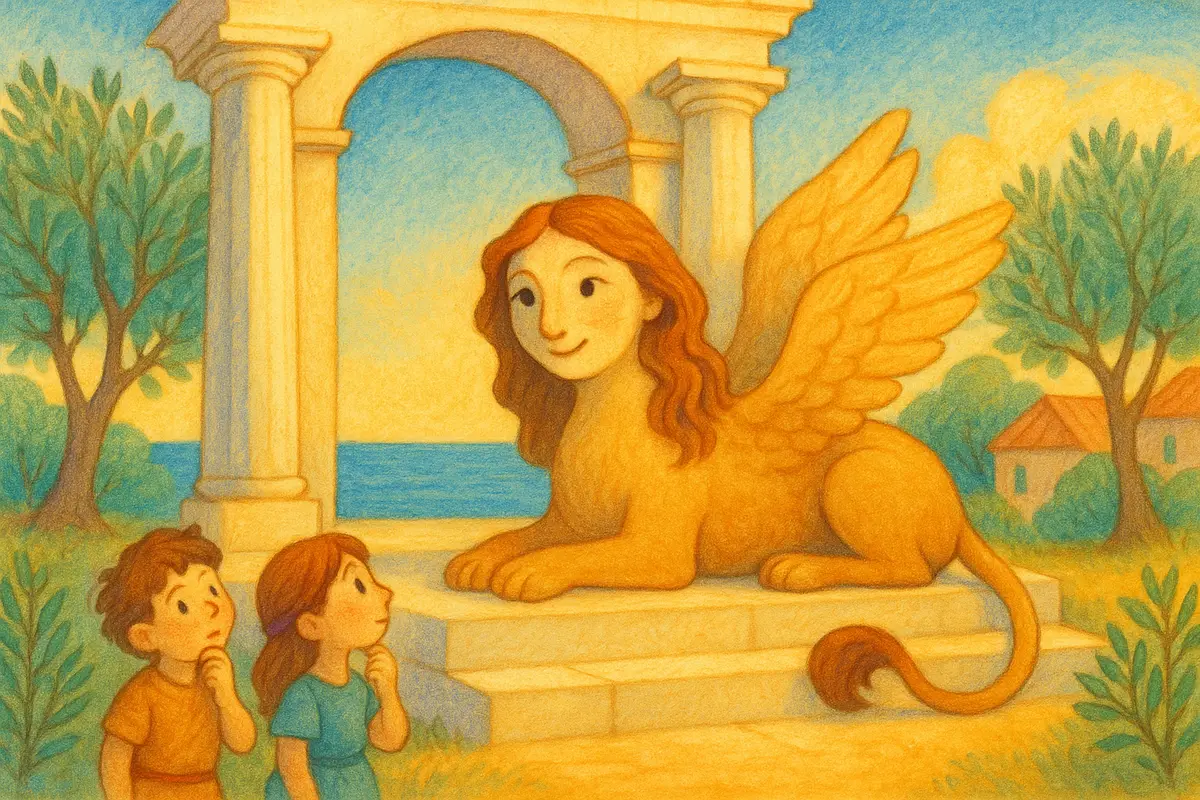
You climb the sunny road and come to a tall marble gate. On the steps sits a sphinx, big as a lion, with golden wings and a kind, gentle face.
"None may pass," she says, "until they answer my riddle." She is not cross. She likes a good thinking face.
What could you do? Could you listen closely and think it through together? A brave guess is allowed too. Try something and see.
When you answer, the sphinx dips her wings and lets you by. "Well thought," she purrs. The gate swings open.
The road climbed into the sun, and at the top stood a tall gate of white marble. On its warm steps lay a sphinx, her body a lion's, her wings folded gold, her face calm and curious. She watched you with the patience of someone who has all the time in the world.
"None may pass," she said, "until they answer my riddle." There was no cruelty in it. If anything, she looked pleased to have visitors who might actually think.
Will you listen closely and puzzle it out together? A brave, thoughtful guess is welcome too. What do you try?
When your answer came, the sphinx dipped her great wings and drew the gate aside. "Well thought," she said, almost smiling, and let you through.
For the grown-up: the solution
The challenge. The Riddle Sphinx will not open the gate until the players answer her riddle. She is fair and patient, and she enjoys a good thinking face.
The riddle. Read it aloud: "I have roots that nobody sees. I am taller than the tallest trees. Up, up, up I go, and yet I never grow. What am I?" The answer is a mountain (think of Olympus rising above you).
Intended solution. This is a thinking challenge of Imagination and a little Vocabulary. Let the children talk it through together. The sphinx accepts the right answer, and because she is kind, she also accepts a brave, thoughtful guess.
Fallback. If they are stuck, the sphinx offers a clue ("You can see me from your town, and the gods live on my head"), or Bramble the satyr whispers the answer from behind a rock. A guess made bravely still opens the gate.
Make it simpler. Ask "what is huge, made of rock, and has snow on top?" and point out of the window at a hill, and any answer like "a mountain" opens the gate.
Stop 2: The Winding Maze
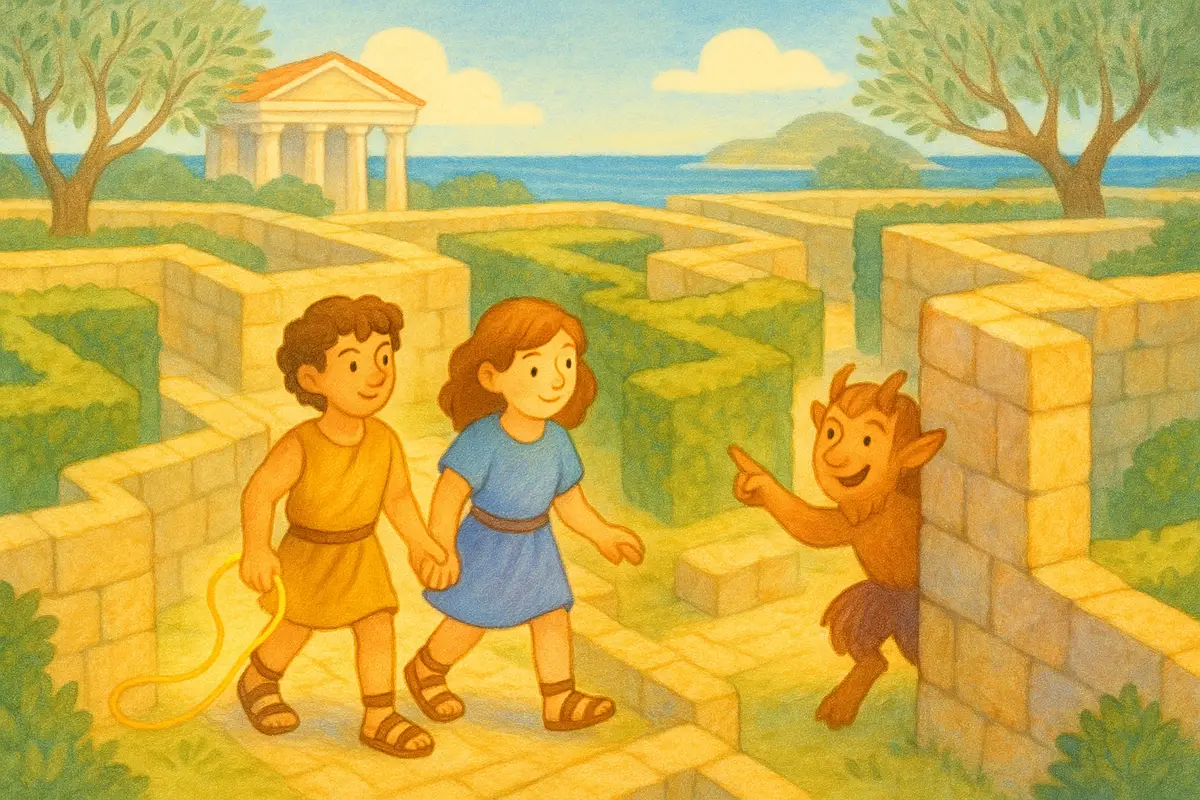
Past the gate is a maze of old stone walls. Every path looks the same. It would be easy to get lost.
A cheerful satyr with goat legs pops his head over a wall. It is Bramble. He hums a little tune and points down one path with a wink.
How will you keep from getting lost? You have a ball of golden thread. What could you do with it? Could you ask Bramble for a hint?
When you tie the thread at the start and follow it on, you never lose your way. You come out the other side, into the evening light.
Beyond the gate the path split, and split again, into a maze of old stone walls where every turning looked exactly like the last. One wrong choice and you might wander until dark.
A goat-legged satyr swung up onto a wall, grinning. It was Bramble, who loved a traveller and a good joke in equal measure. He hummed a tune and tipped his head down one shadowed lane.
How will you keep from losing your way? You carry a ball of golden thread, and Bramble seems willing to help. What is your plan?
By tying the thread at the entrance and letting it trail behind you, every step became a step you could undo. The maze could not trap a hero with a thread, and soon you stepped out into the long golden light of evening.
For the grown-up: the solution
The challenge. Beyond the gate is a maze of stone walls where every path looks the same. The players must find their way through without getting lost.
Intended solution. This is a Spatial and Logic moment. The good idea is to use the golden thread: tie one end at the entrance and unspool it as you go, so you can always retrace your steps and never walk the same wrong path twice. Marking each turn, or asking Bramble the Satyr for a hint, works just as well.
Fallback. If the children are unsure, have Bramble pop up and point the way with a joke, or let them spend an energy star to "remember" the route. Getting through with help still counts as a full success and tops up an energy star.
Make it simpler. Let the child trail a real piece of string or wool behind them along the maze on the map, then follow it back out: that is the puzzle solved.
Stop 3: The Lonely Giant
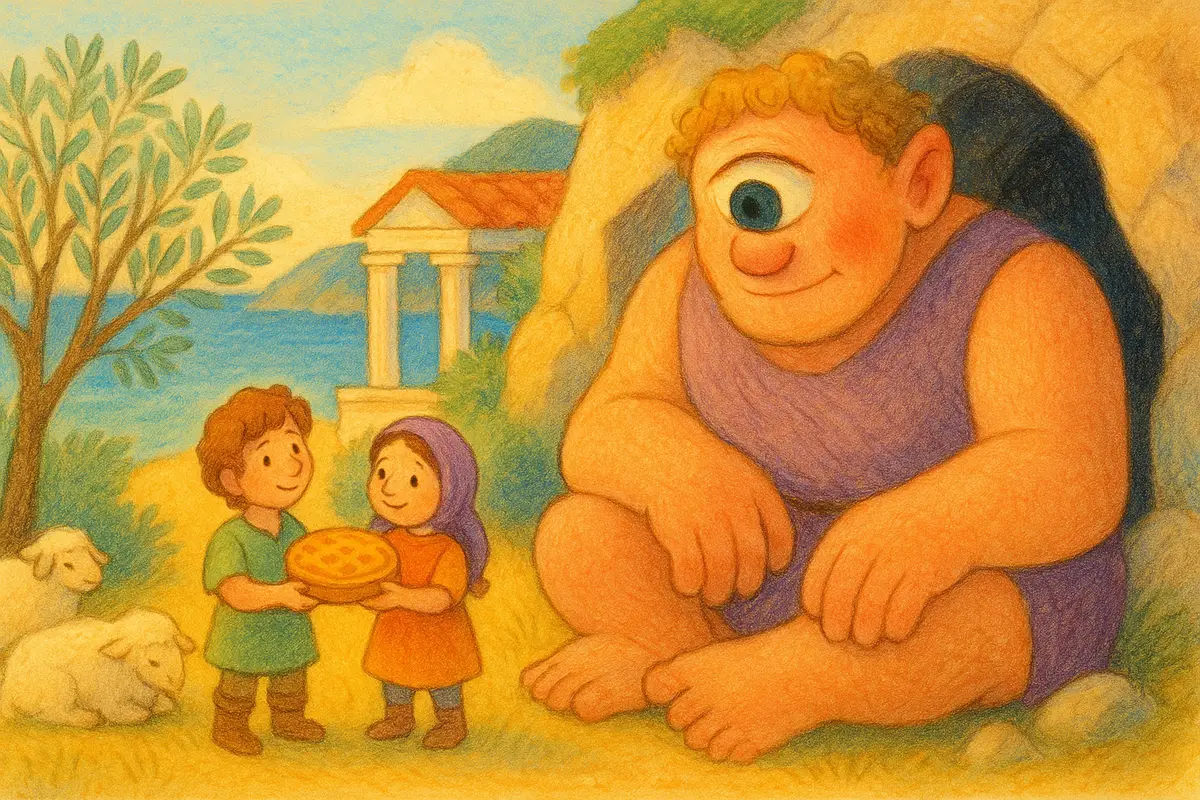
At last you reach the spring. But a huge giant sits in front of it, with one big eye and a deep, sad face. He folds his arms. He looks fearsome.
But listen. He sniffs. Is he, maybe, a little bit lonely? Nobody ever comes to visit him.
This is not a fight. What kind thing could you do? You have a honey cake to share. You could ask his name. You could tell him he is not alone. What do you try?
When you are kind to him, the giant's big eye fills with happy tears. He shuffles aside. "Thank you for being my friends," he says softly.
And there, at last, was the spring. But a giant sat squarely in front of it: one enormous eye, two folded arms, and a face set hard as the cliff behind him. Your heart thumped. He looked, for a moment, like the end of the adventure.
Then he sniffed. And you understood. He was not angry. He was lonely. No traveller had ever stayed to speak with him, and the long silence had made him gruff.
This was never a fight. What kindness could you show him? You have a honey cake to share. You could ask his name, or simply tell him that he is not alone. What do you do?
When you offered your kindness, the giant's huge eye brimmed over, and he wiped it with the back of one enormous hand. "You stayed," he whispered, as though he could hardly believe it. "You are my friends." And he shuffled, very gently, aside.
The Spring Sings Again
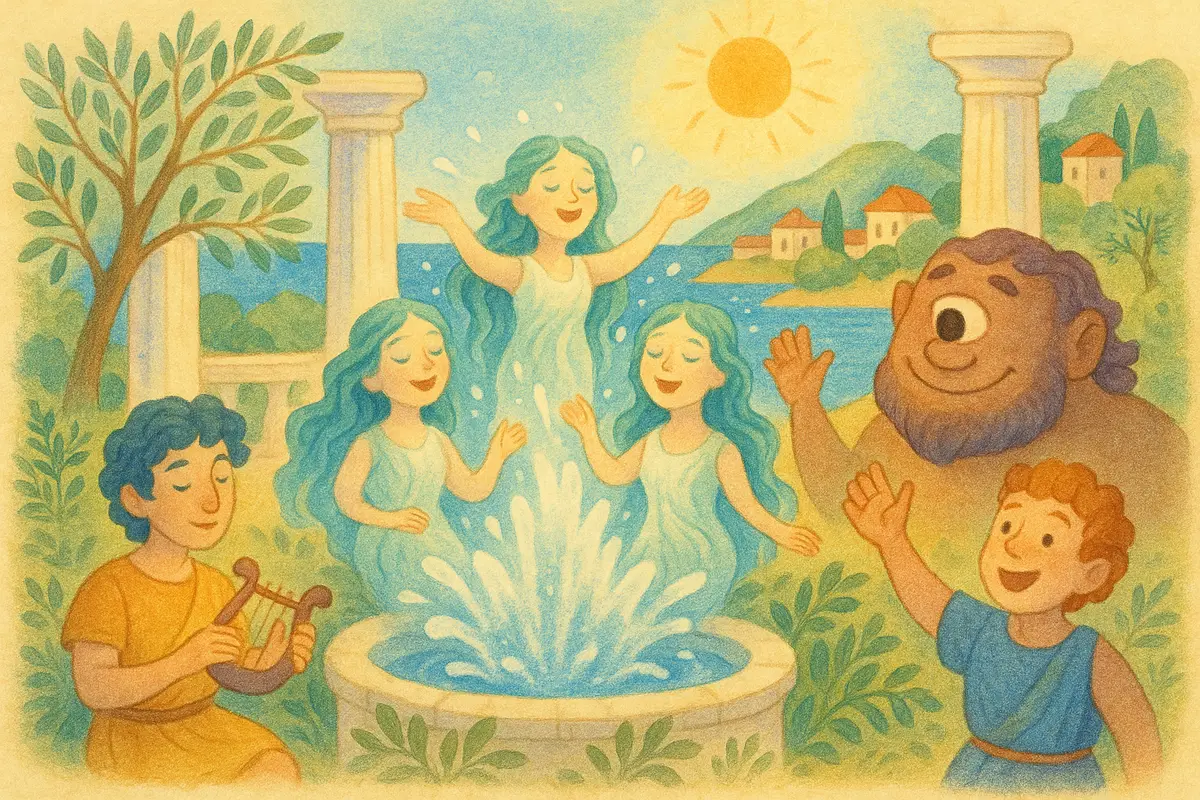
Now you stand at the quiet spring. You take out the little lyre and play a simple tune, straight from the heart.
The water shivers. Gentle nymphs rise up in the spray, laughing and singing. The spring bursts back to life! Far below, every well in the town fills up cool and clear.
High on the mountain, kind Athena smiles down at you. You did it together. You were brave, you were full of ideas, and most of all, you were kind. Well done, heroes.
You stood at the edge of the quiet water and lifted the little lyre. The tune you played was simple and a touch wobbly, but it came straight from the heart, and that was all the spring had been waiting for.
The surface trembled. Up through the spray rose the Singing Nymphs, laughing, their voices weaving into a song so bright it seemed to lift the whole hillside. The spring leapt back to life, and far below, every well in the Olive Town brimmed cool and clear once more.
High on cloud-wrapped Olympus, kind Athena looked down and smiled. You had done it, and you had done it together: with your ideas, with your courage, and above all with your kindness. Well done, heroes of the Sunlit Hills.
Here nobody loses. If a try does not work, you just find another way.
Read aloud together, pause often, and try ideas. There are no wrong answers.