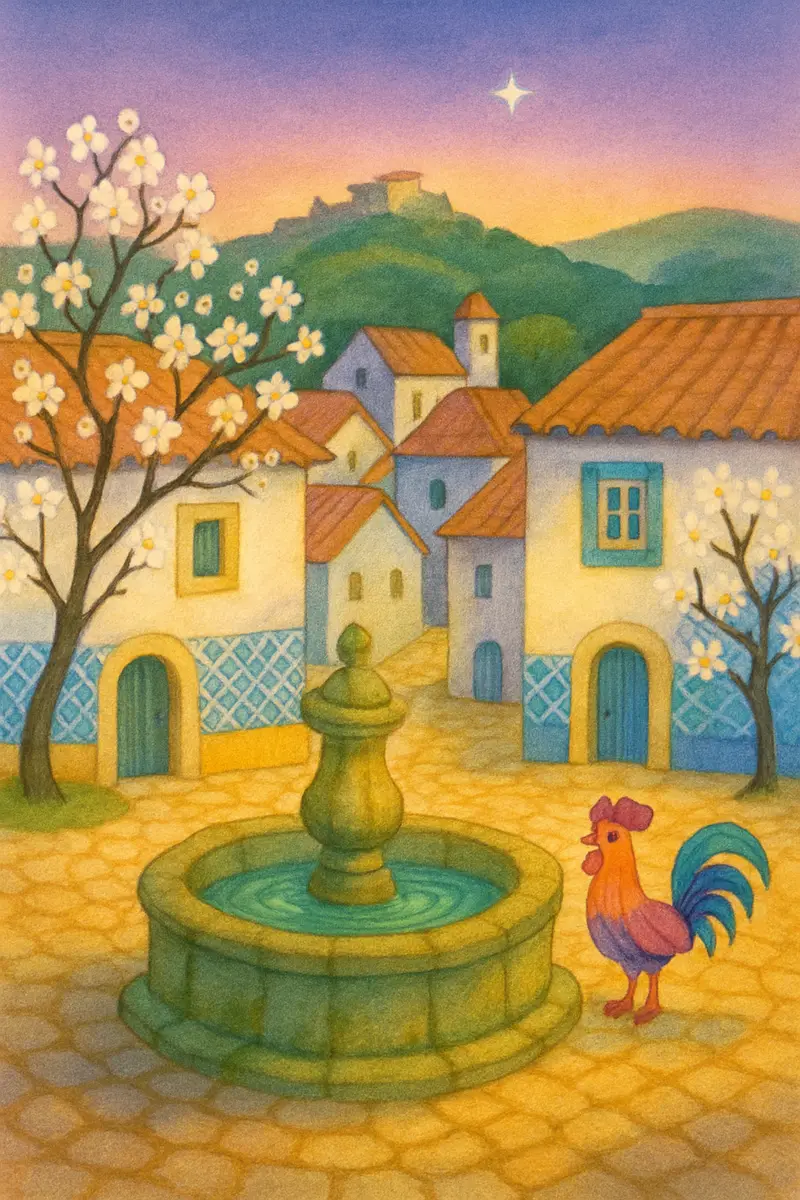
a story from The Enchanted Springs of Portugal
Queen Isabel's Roses
In the old city of Coimbra lived good Queen Isabel, who loved to carry bread to people who were hungry. She did it quietly, because she did not want any...
Reading level
Same story, gentler or richer words.
The Enchanted Springs of Portugal
In the enchanted springs of Portugal, cobblestone towns sit among terracotta roofs, almond trees that blossom white as snow, and hills crowned with stars. Water is the magic here: every spring, fountain, and old stone well has its own quiet wonder. Enchanted maidens called the Mouras keep the springs sweet, a bright rooster crows only the truth, and a playful little goblin called the Trasgo tidies and teases when no one is looking. Here a hero wins not by being the strongest, but by being kind, asking the water gently, and never giving up on a friend. Even a big, fearsome-looking giant of the hills usually turns out to be lonelier than it is frightening.
Read aloud, slowly and warmly. Stop often to let the children answer. There are no wrong answers here, only new ideas to try.
Read aloud, or let an older child read it themselves. Pause often so everyone can puzzle, wonder, and try ideas. There are no wrong answers here, only new paths to follow.
Before you begin
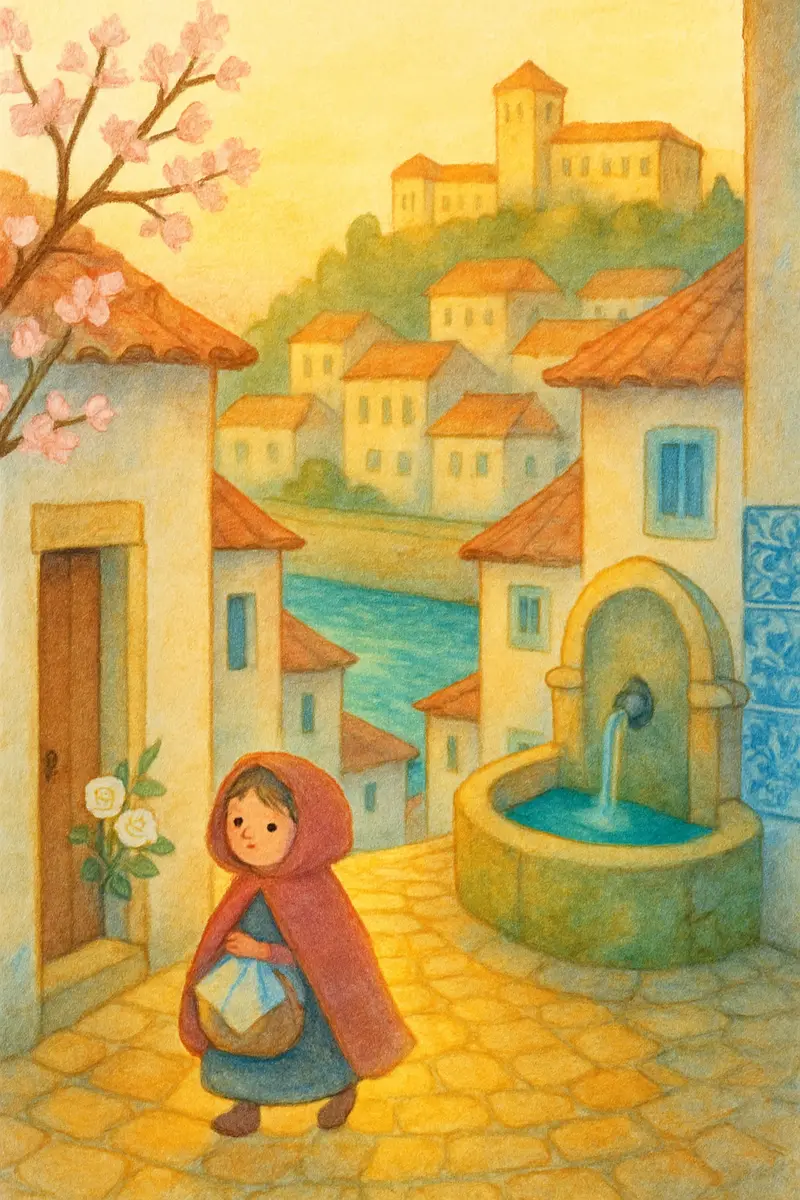
In the old city of Coimbra lived good Queen Isabel, who loved to carry bread to people who were hungry. She did it quietly, because she did not want any thanks.
This morning the Queen is unwell and cannot go out. "Will you carry the kindness for me?" she asks you gently. "Take some bread to those who need it, and do it softly, the way I would."
You pick up your bag. "We will," you say. The city is waking up below the castle.
What is your hero name? Which one or two magics do you choose: Bloom, Truth, Starlight, Riversong, or Birdsong?
In the old riverside city of Coimbra, with its climbing stone streets and its castle on the hill, there lived a queen the people loved: good Queen Isabel. Her delight was to carry bread to those who had none, and she did it in secret, slipping out at dawn with a covered basket, because a kindness done for thanks, she said, is only half a kindness.
On the morning this story begins, the Queen was unwell and could not rise. She called you to her side and pressed her warm hands over yours. "I cannot make my round today," she said, "and there are hungry mouths who will go without. Will you carry the kindness in my place? Take bread to those who need it, and do it softly, the way I would, asking nothing back."
You promised that you would, and went down toward the waking city, the castle bells tolling gently behind you.
What is your hero name? Which one or two magics will you carry: Bloom, Truth, Starlight, Riversong, or Birdsong?
For the grown-up Setup, the rules, and the answers. Open it when you are ready (it has spoilers).
Queen Isabel's Roses: Rules for the Grown-Up
The Guide for the Grown-Up explains how the game works (the difficulty bands, the energy stars, helping, twists, all of it). This page has only what is special about this adventure. A failed roll is never a defeat; nobody loses.
Setting up
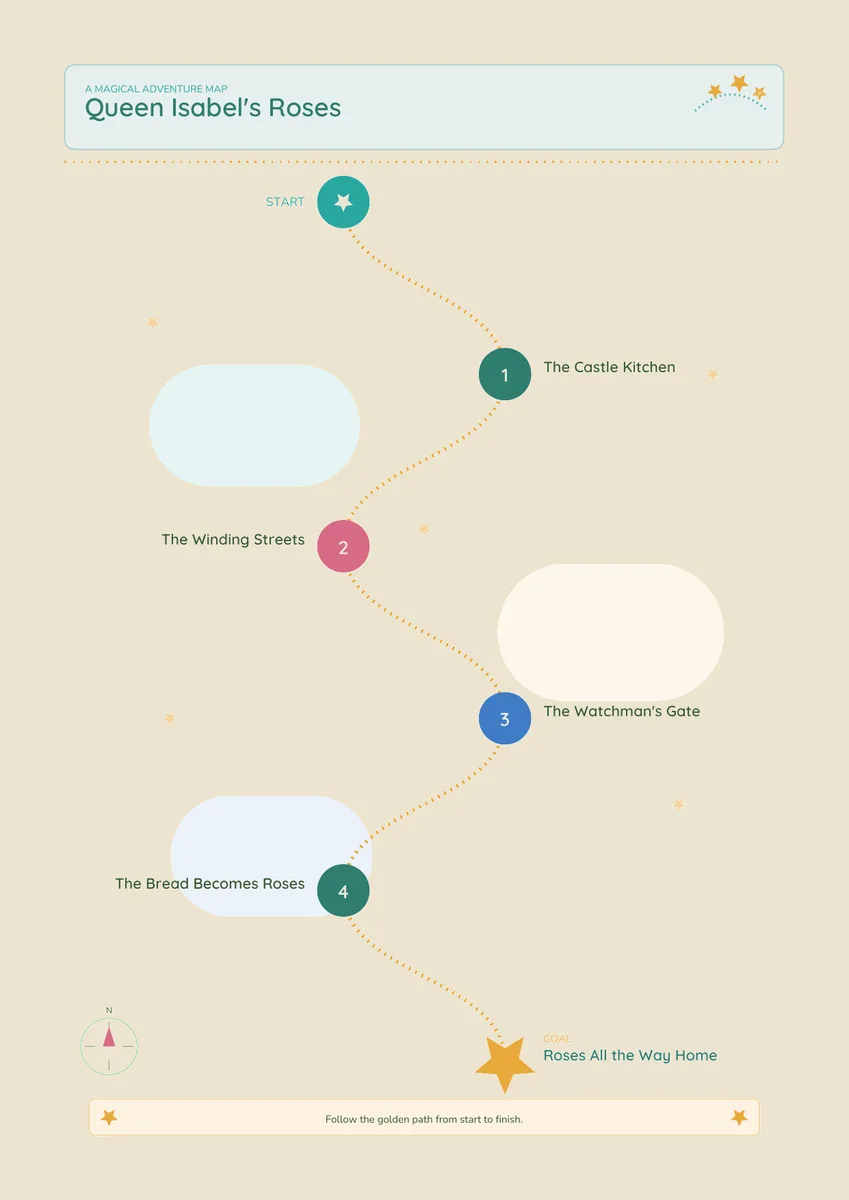
- Print the map, or sketch it, or lay it out with household objects: a Start, four stops, and a Goal on a winding path. Each player puts a small figure on the Start.
- Each player chooses one or two magics from the five in this world: Bloom, Truth, Starlight, Riversong, or Birdsong. Bloom shines in this story, but a mix works best.
- Give each player five energy stars (five small tokens or bricks). These are spent and refilled during play.
- Build the things that come up (the covered basket, the loaves, the roses) from household bits and bricks as you go. Anything can be anything.
- Keep your dice and the dice-band table from the back of the kit beside you.
The surprise
Once at each stop the players may roll for a twist; read the matching line. The Guide explains how it works.
| Roll | Surprise |
|---|---|
| 1 | A baker slips you a warm loaf and one free hint. |
| 2 | You find a coin in the cobbles: take back one energy star. |
| 3 | A kind neighbour points the way: the next challenge is Easy. |
| 4 | A waft of rose scent drifts by. All is well; carry on. |
| 5 | Queen Isabel's blessing lets you repeat one roll later, whenever you like. |
| 6 | A bell rings over the river and everyone feels brave for one turn. |
How it ends
There is no villain in this story. The stern watchman is only doing his duty, and he is won over by honesty, not defeated. The climax is the gentle miracle the legend is famous for: the bread the children carry turns to roses, so a secret kindness is protected and nobody is scolded. Play it as a reward for honesty and quiet generosity, not a trick to fool anyone. The lesson is that kindness given softly, asking nothing back, is the kind that blooms. See the puzzles page for how to play each stop, and for the solutions.
Stop 1: The Castle Kitchen
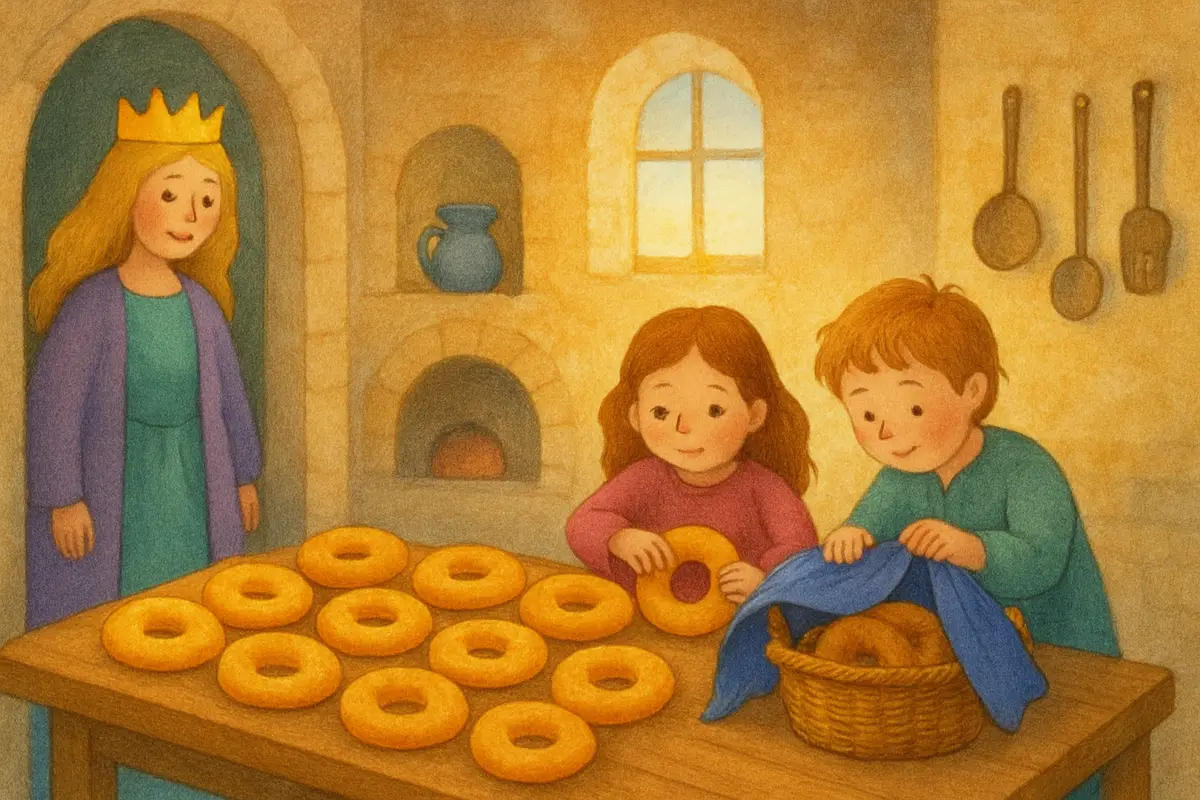
You slip into the warm castle kitchen. On the long table are golden loaves of rosca bread, more than the castle could ever eat. The cook is dozing by the fire.
You want to take just enough to share, quietly, without waking anyone or taking more than is fair.
How many loaves do you take, and how do you carry them out softly? How do you keep the kindness a secret? What do you try?
When your basket is full and covered with a cloth, you tiptoe out into the morning. Nobody stirs.
The castle kitchen was warm and golden, and its long table was heaped with rosca bread, ring upon ring of it, far more than the castle could eat before it went stale. By the hearth the old cook dozed, chin on chest, snoring softly.
Your task was a quiet one: to take only enough to share, no more than was fair, and to carry it away without waking the cook or drawing any eye, so the giving stayed as humble and secret as the Queen wished.
How much do you take, and how do you carry it out without a sound? How do you keep the kindness from being noticed? What is your plan?
When your basket held just enough, covered over with a clean cloth, you stepped out into the cool morning air without so much as a creak of the door. The cook slept on, none the wiser.
For the grown-up: the solution
The challenge. Take only a fair share of the rosca bread and carry it out quietly, without waking the dozing cook or making the giving showy.
Intended solutions. A gentle planning moment:
- Truth to judge honestly how much is fair to take and no more.
- Riversong to hush a creaky door or a sloshing jug so nobody stirs.
- A plain careful plan: counting out just enough loaves, padding the basket with the cloth so it makes no sound, tiptoeing past the hearth.
Fallback. If the children hesitate, have a kitchen cat lead them to the day-old loaves meant for sharing, settling the "how much is fair" question. Any quiet, fair plan works and tops up an energy star.
Make it simpler. For a younger child, just choosing two loaves and covering the basket with a cloth is the whole of it.
Stop 2: The Winding Streets
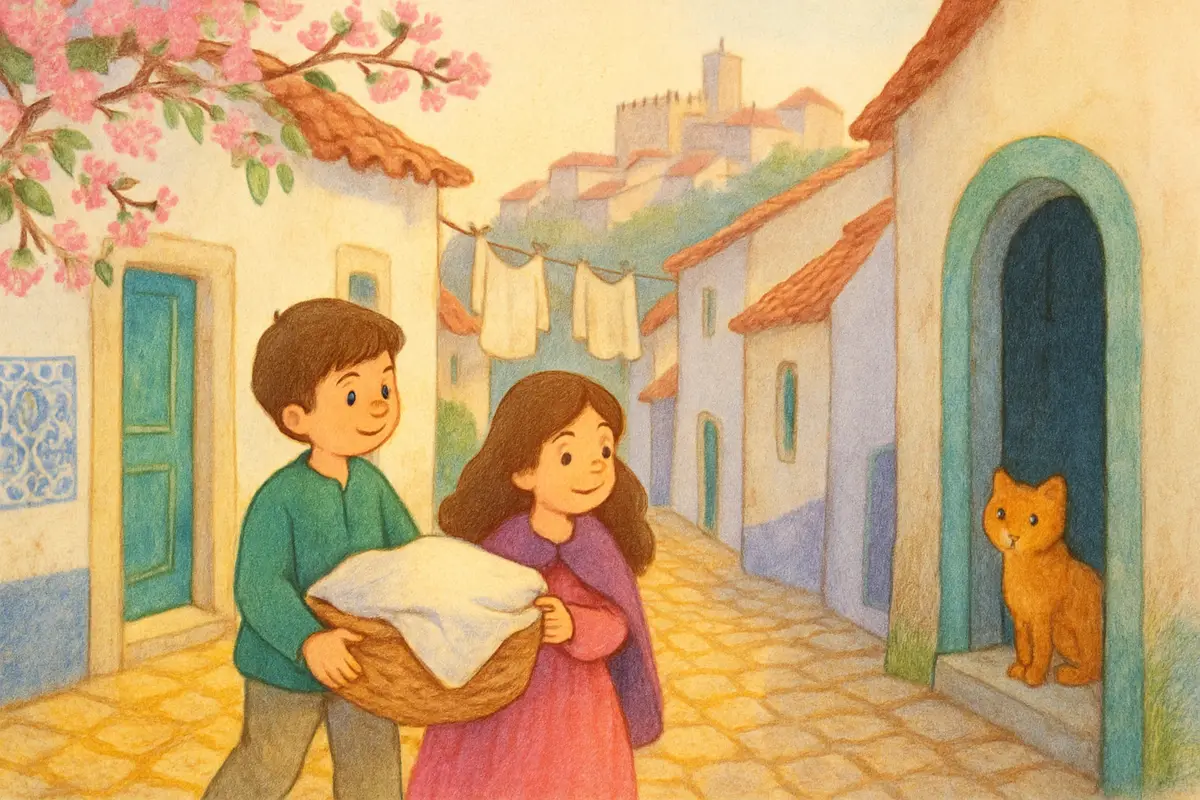
You carry the covered basket down the narrow, winding streets. But who needs the bread most? You look around carefully. A door with no smoke from its chimney. A thin cat by a step. A small face at a cold window.
Who do you think needs help this morning? How can you tell? How will you give the bread so nobody feels ashamed?
When you leave bread softly at the right doors, with a kind word and no fuss, people smile in surprise. The streets feel warmer already.
You carried the covered basket down into the maze of narrow streets, and there came the harder question: of all these doors, who needed the bread most? The Queen never gave at random; she gave where it mattered. So you looked closely, the way she would have. A chimney with no smoke rising. A doorstep where a thin cat waited in hope. A small, pale face at a window with no breakfast behind it.
Who do you think is in need this morning, and how can you tell? And how will you give the bread so that nobody is shamed by taking it?
When you left your loaves quietly at the right doors, with a soft word and never a fuss, the people who found them looked up in astonished gladness, and could not think whom to thank. The cold streets seemed to warm behind you as you went.
For the grown-up: the solution
The challenge. Work out, from small signs, who in the streets most needs the bread, and give it so nobody feels ashamed.
Solution. The clues are the cold details: a chimney with no smoke, a thin cat waiting, a pale child at a bare window. The players read these signs of need and leave bread quietly at those doors, with a kind word and no fuss. This is observation and empathy, not a magic, though Starlight can light a dim doorway, Bloom can leave a small flower as a gentle, face-saving gift beside the loaf, and Birdsong can send a little bird ahead to find the quiet door where someone waits hungry.
Fallback. If the children are unsure, have a neighbour murmur which house has had no bread this week. Choosing kindly, even with a hint, is a full success and tops up an energy star.
Make it simpler. For a younger child, set out two doors, one warm and one cold, and ask only which one needs the bread.
Stop 3: The Watchman's Gate
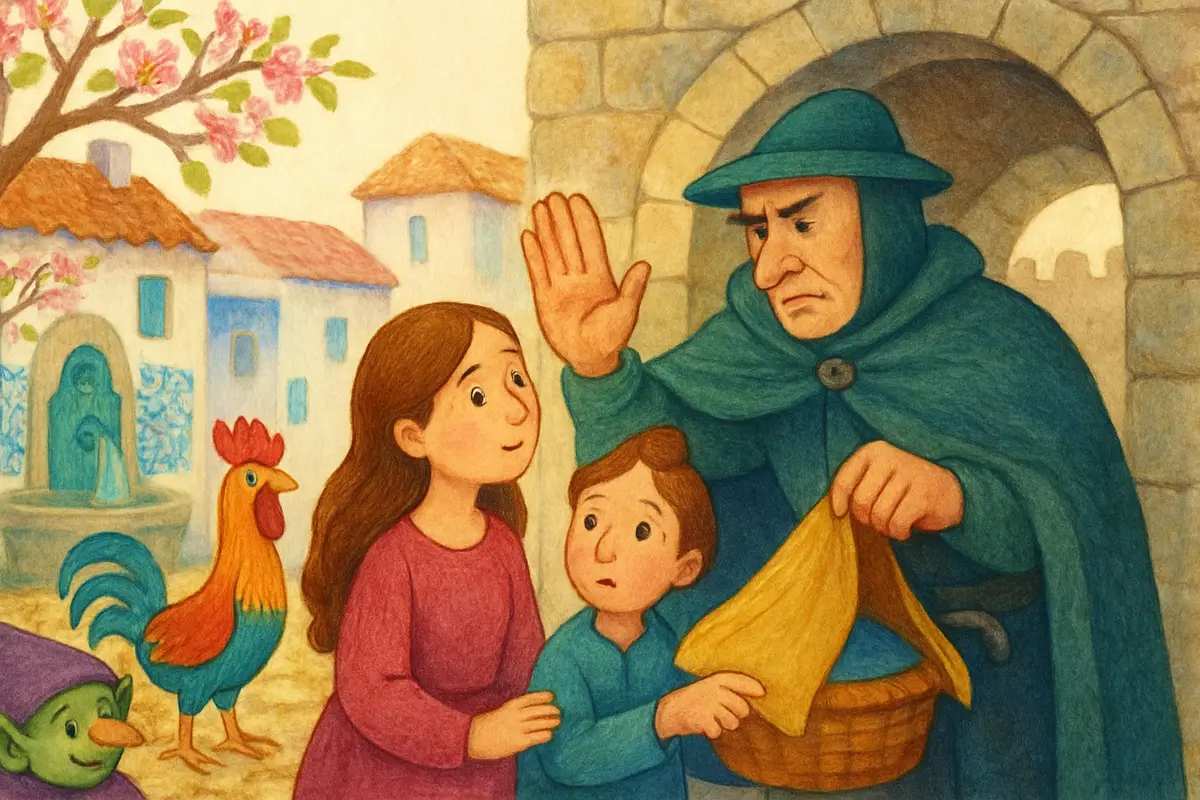
At the castle gate stands the watchman. He is big and stern, and he stops you. "What is under that cloth?" he asks, frowning. "The King says the castle's bread must not be given away."
He is not really unkind. He is only doing his job. But he wants to look in your basket.
What do you say to the watchman? Do you tell him the truth? How can you show him that sharing bread is a kind and good thing?
When you answer honestly and kindly, the watchman's frown begins to soften. "Show me, then," he says, more gently now. "Lift the cloth."
But to come and go from the castle you had to pass the gate, and at the gate stood the watchman: broad, stern, and sharp-eyed, with orders to keep. He stepped into your path and held up a hand. "Hold there. What is it you carry under that cloth?" he demanded. "The King has said plainly that the castle's bread is not to be given away at the gate, and I mean to see what you are about."
He was no villain, only a man doing his duty as he understood it, and he would not simply wave you through. He wanted the basket opened.
What do you say to the watchman? Will you tell him the truth of your errand? How can you help him see that carrying bread to the hungry is a good and gentle thing, worth his blessing rather than his blame?
When you answered him honestly, without fear and without a lie, and spoke of the Queen's kindness as the good thing it was, the hard set of his face began to ease. "Very well," he said, gentler now, almost curious. "Lift the cloth, then, and let me see for myself."
For the grown-up: the solution
The challenge. The stern watchman blocks the gate and demands to see inside the covered basket. The players must win him over with honesty and kindness, not a lie and not a fight.
Intended solutions. A social, honest-heart moment:
- Truth is the natural fit: answer him plainly about the errand and the Queen's kindness, with nothing hidden.
- A warm, brave word: explain that the bread is for the hungry and ask for his blessing rather than his blame.
- Bloom or a shared loaf can thaw his mood and show good will.
Fallback. If the children freeze, have the watchman's own stomach rumble, prompting a child to offer him a loaf, which softens him at once. Any honest, gentle answer makes him relent and ask to see the basket.
Make it simpler. For a younger child, simply telling the watchman "it is bread for people who are hungry" is enough to win him over.
Stop 4: The Bread Becomes Roses
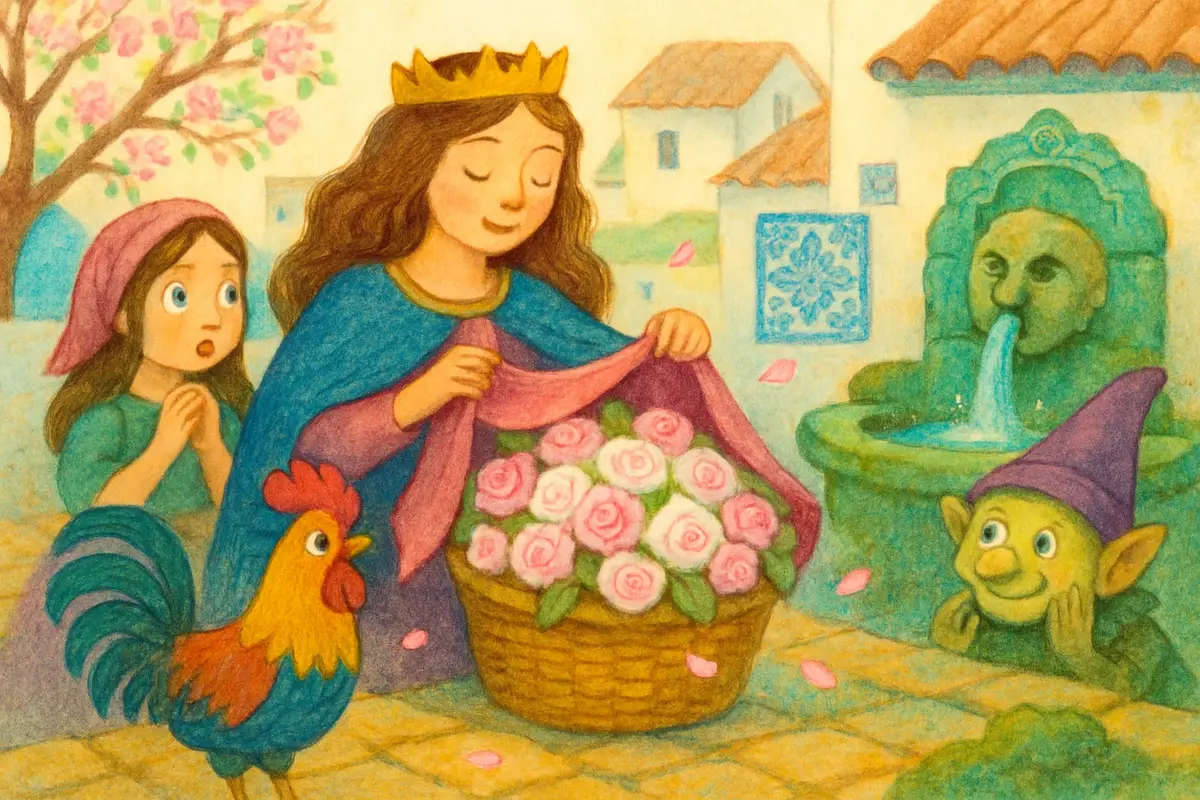
You take a deep breath and lift the cloth from the basket, ready to tell the whole truth. But inside there is no bread at all.
The loaves have turned into roses. The basket is full of fresh white and pink roses, spilling over the rim, even though it is not the season for them.
How does that make you feel? What do you say? Can your Bloom magic help the roses shine even brighter?
The watchman stares, and his stern face breaks into a smile. There is nothing to scold here, only flowers. The Queen's secret kindness is safe, wrapped up in a small, sweet miracle.
You drew a steadying breath and lifted the cloth, ready to show him everything and tell the whole truth, come what may. But under the cloth there was no bread at all.
Where the golden loaves had lain, the basket now brimmed with roses: fresh white and blushing pink, heavy with dew and scent, tumbling over the rim, though it was far from the season any rose should bloom. The kindness had become a small, bright miracle in your hands.
How does this make you feel, holding a basket of impossible roses? What do you say to the watchman now? Could your Bloom magic help the roses open fuller and brighter still?
The watchman looked, and looked again, and the sternness simply fell from him. There was nothing here to forbid, nothing to scold, only flowers out of season and a secret too gentle to punish. The Queen's quiet giving was safe, hidden inside a wonder, and the watchman, of all people, found he was smiling.
For the grown-up: the solution
The challenge. Lift the cloth and show the watchman the truth, trusting that kindness done honestly will come right. There is no roll to fail; the miracle rewards the children's honesty.
Intended solution. Have the players bravely lift the cloth to reveal the bread has become roses. Bloom fits beautifully here, helping the roses open fuller, but the wonder happens for any child who chose honesty at the gate. Let them enjoy the watchman's astonishment.
Fallback. If a child is anxious about opening the basket, let the roses' scent escape first, hinting that something lovely waits inside, so lifting the cloth feels safe. The success is guaranteed.
Make it simpler. For a younger child, simply lifting the cloth and discovering the roses together is the whole of it.
Roses All the Way Home
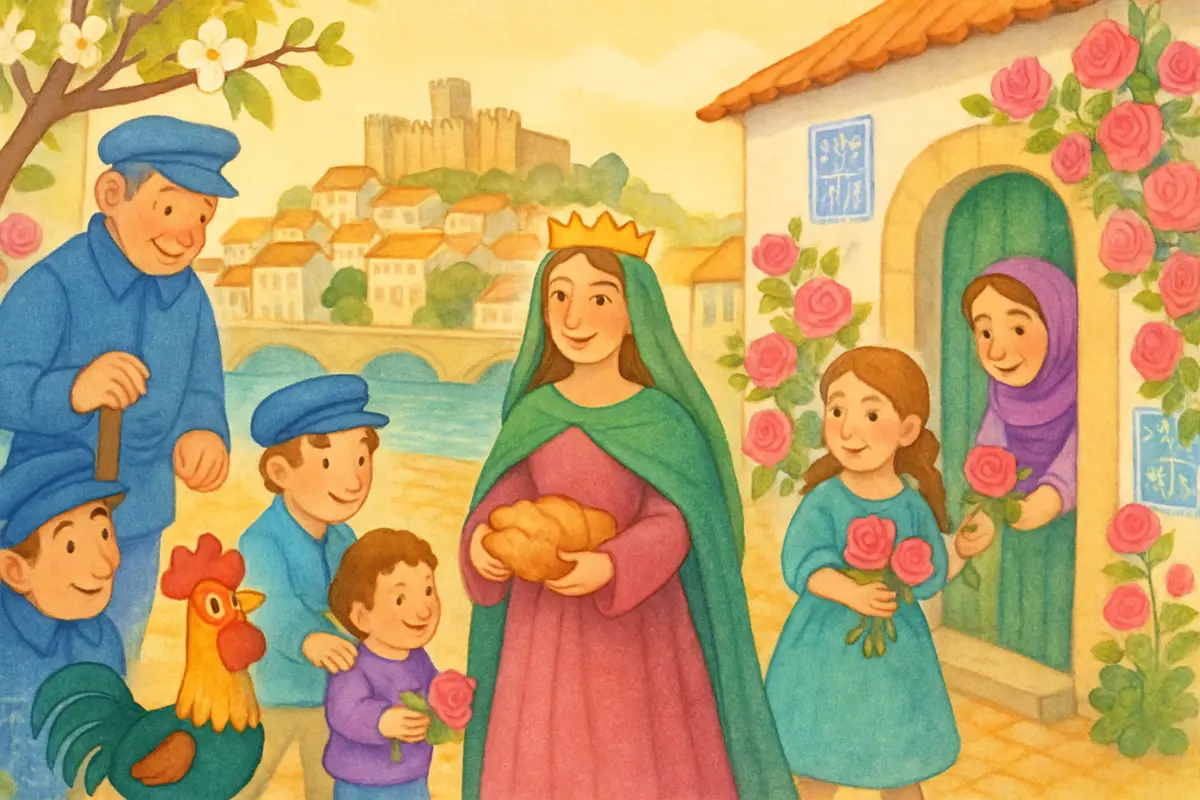
As you walk back, roses begin to bloom along the walls and in the doorways, all through Coimbra. People come out to look and to share what they have. The watchman himself picks up a basket to help carry bread the next morning.
Queen Isabel hears the happy noise from her window and smiles. Kindness given quietly has filled a whole city with flowers.
You did it together. You were kind, and you were full of ideas. Well done.
As you made your way back through Coimbra, the roses would not stay in the basket. They began to bloom along the tops of the walls, around the door frames, in the cracks of the old stone steps, until the whole climbing city wore them like a garland. People came out to wonder, and finding themselves glad, began to share whatever they had with one another.
The watchman picked up an empty basket and asked, almost shyly, if he might help carry bread come the next dawn. And high in her room good Queen Isabel heard the laughter rising from the streets, and smiled to herself, for she knew that a kindness done softly had filled an entire city with flowers.
You did it together. You were honest when it would have been easier to hide, and you were kind when no one was watching, which is the kindest kind of all. Well done.
For the grown-up: the solution
This is the resolution, not a puzzle, so there is no band and no roll. Roses bloom through Coimbra, neighbours share what they have, and the won-over watchman offers to help carry bread next dawn. Let the children feel the whole city soften and Queen Isabel's quiet smile. They won by being honest and generous when no one was watching, which is the only way anyone wins among the Enchanted Springs.
Here nobody loses. If a try does not work, you just find another way.
Read aloud together, pause often, and try ideas. There are no wrong answers.