a story from The Enchanted Springs of Portugal
The Moura's Lost Comb
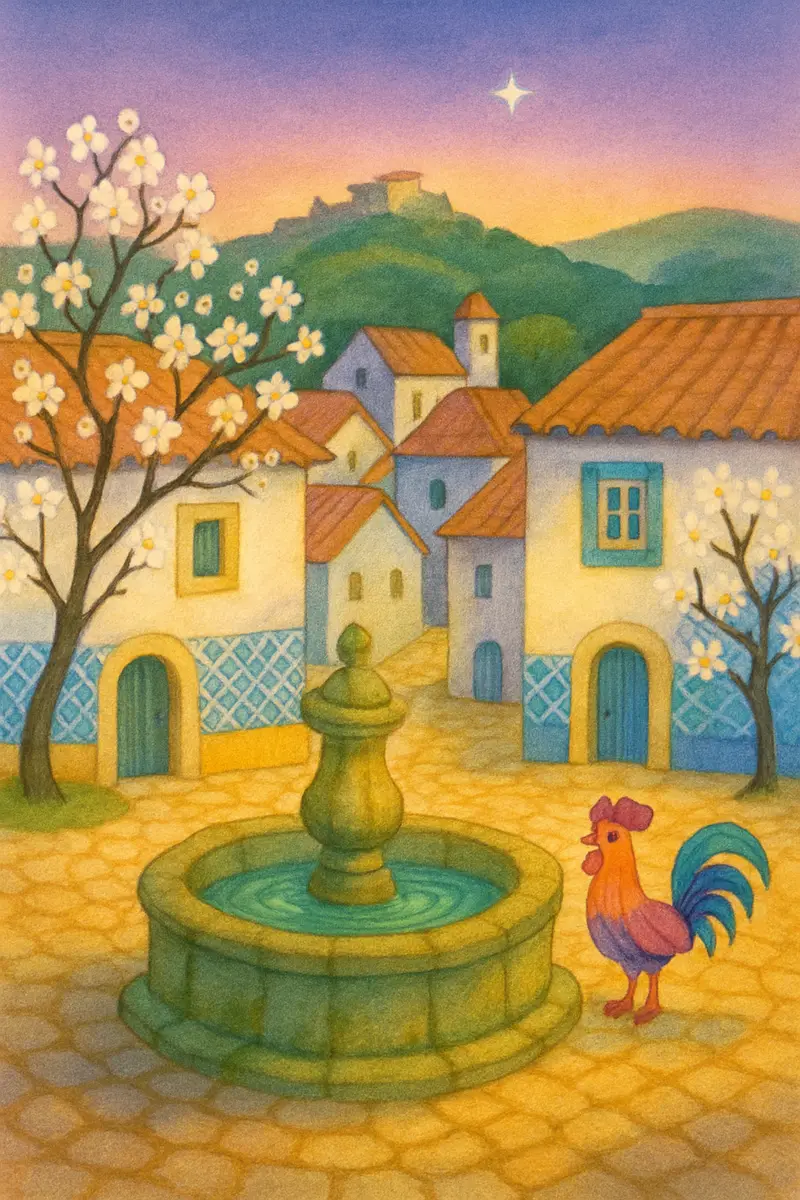
This morning the village square is full of worried voices. The Old Fountain has gone quiet. Its water sits still and grey, and nobody can fill their jugs.
Reading level
Same story, gentler or richer words.
The Enchanted Springs of Portugal
In the enchanted springs of Portugal, cobblestone towns sit among terracotta roofs, almond trees that blossom white as snow, and hills crowned with stars. Water is the magic here: every spring, fountain, and old stone well has its own quiet wonder. Enchanted maidens called the Mouras keep the springs sweet, a bright rooster crows only the truth, and a playful little goblin called the Trasgo tidies and teases when no one is looking. Here a hero wins not by being the strongest, but by being kind, asking the water gently, and never giving up on a friend. Even a big, fearsome-looking giant of the hills usually turns out to be lonelier than it is frightening.
Read aloud, slowly and warmly. Stop often to let the children answer. There are no wrong answers here, only new ideas to try.
Read aloud, or let an older child read it themselves. Pause often so everyone can puzzle, wonder, and try ideas. There are no wrong answers here, only new paths to follow.
Before you begin
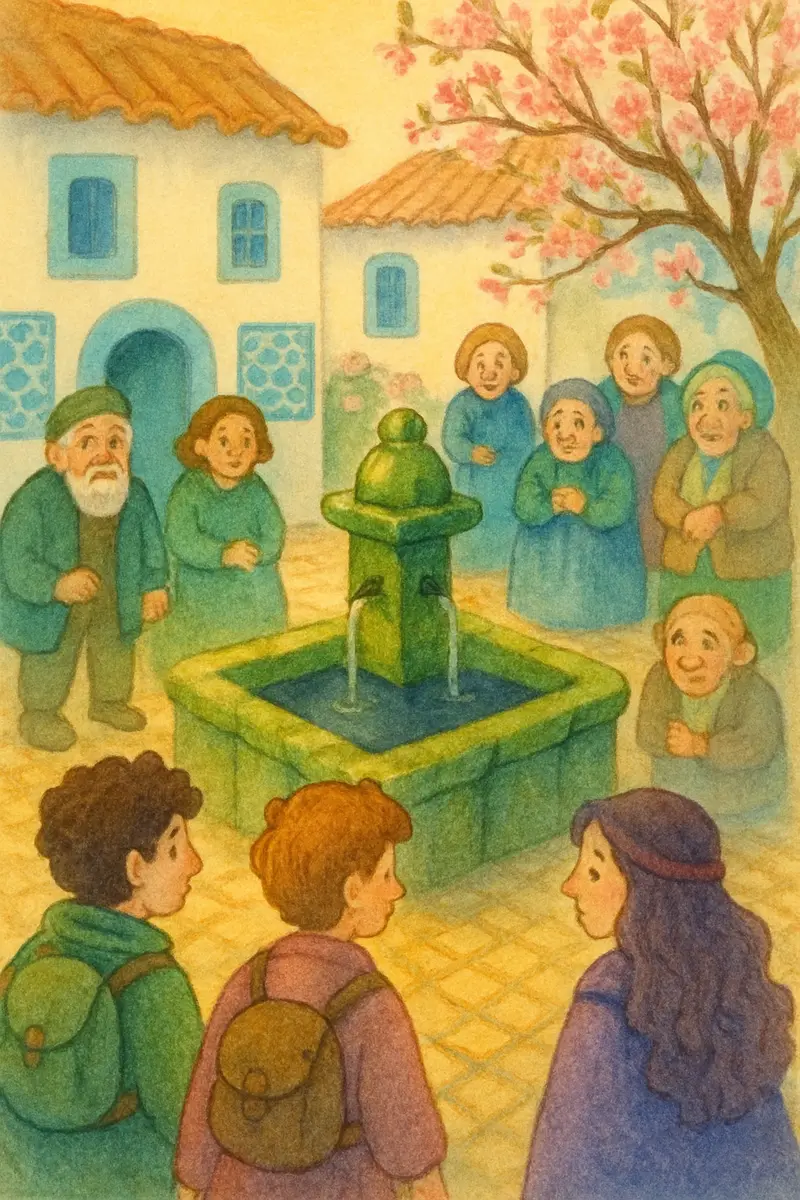
This morning the village square is full of worried voices. The Old Fountain has gone quiet. Its water sits still and grey, and nobody can fill their jugs.
You stand at the edge of the square. An old woman says, "The fountain is fed by the Enchanted Spring, up in the hills. Something has gone wrong up there. Will you go and see?"
You pick up your bag. You look at each other and nod. The path winds up into the green hills.
What is your hero name? Which one or two magics do you choose: Bloom, Truth, Starlight, Riversong, or Birdsong?
The morning you remember best began with worried voices in the village square. The Old Fountain, the mossy stone fountain that has run clear and sweet for as long as anyone can recall, had gone silent overnight. Its water sat grey and still, and a line of villagers stood about it with empty jugs, not knowing what to do.
An old woman in a shawl turned to you. "The fountain is fed by the Enchanted Spring, high in the hills," she said, "and the water only runs sweet while all is well up there. Something has gone wrong. You have brave hearts and quick minds. Will you climb up and find out?"
You shouldered your bag, glanced at one another, and set off. The path wound up out of the square and into the cool green hills, and the further you climbed the quieter the world became.
What is your hero name? Which one or two magics will you carry: Bloom, Truth, Starlight, Riversong, or Birdsong?
For the grown-up Setup, the rules, and the answers. Open it when you are ready (it has spoilers).
The Moura's Lost Comb: Rules for the Grown-Up
The Guide for the Grown-Up explains how the game works (the difficulty bands, the energy stars, helping, twists, all of it). This page has only what is special about this adventure. A failed roll is never a defeat; nobody loses.
Setting up
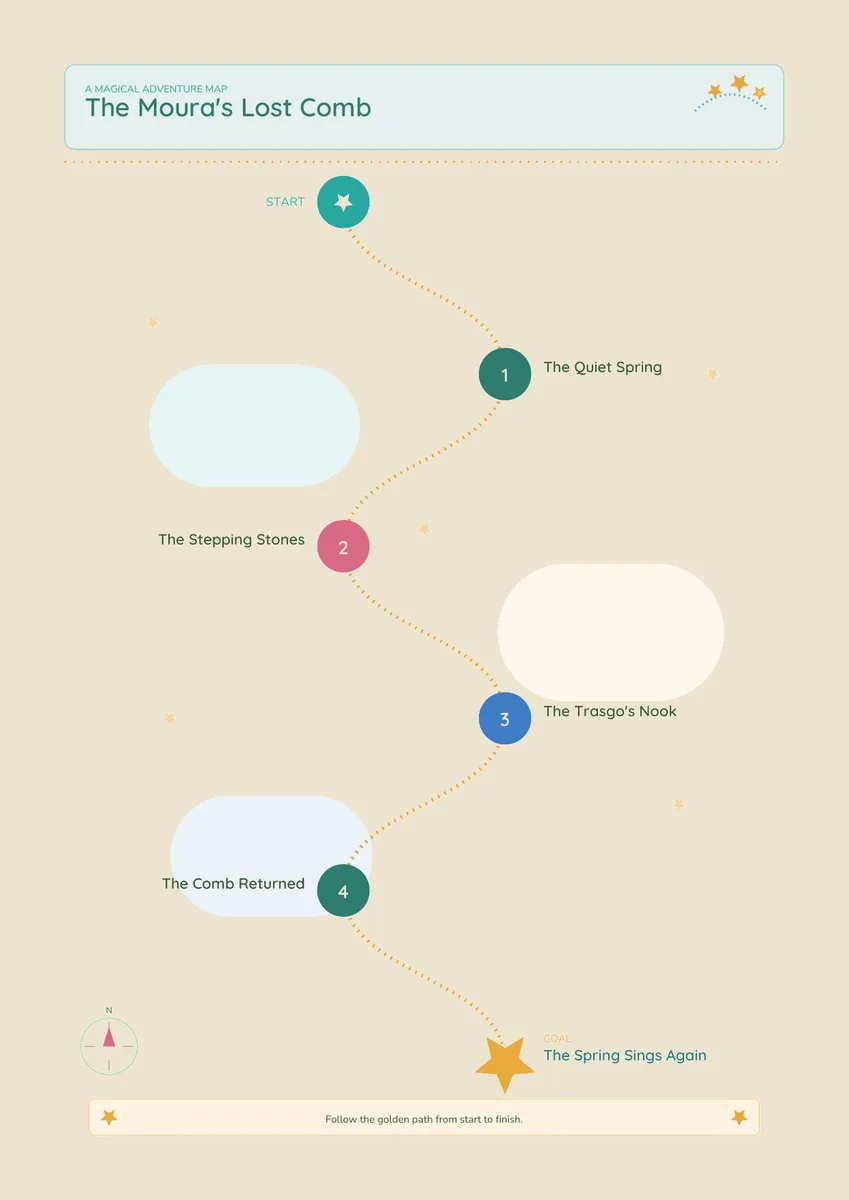
- Print the map, or sketch it, or lay it out with household objects: a Start, four stops, and a Goal on a winding path. Each player puts a small figure (a building-brick minifigure works well) on the Start.
- Each player chooses one or two magics from the five in this world: Bloom, Truth, Starlight, Riversong, or Birdsong. A mix across the players works best, because combining magics is half the fun.
- Give each player five energy stars (five small tokens or bricks). These are spent and refilled during play.
- Build the things that come up (the golden comb, the stepping stones, the Trasgo's shiny hoard) from household bits and bricks as you go. Anything can be anything.
- Keep your dice and the dice-band table from the back of the kit beside you.
The surprise
Once at each stop the players may roll for a twist; read the matching line. The Guide explains how it works.
| Roll | Surprise |
|---|---|
| 1 | The Galo de Barcelos crows nearby and points you to one free hint. |
| 2 | You find a glint of water-light: take back one energy star. |
| 3 | A kind breeze off the hills: the next challenge is Easy. |
| 4 | The Moura hums a few notes of her water-song. All is well; carry on. |
| 5 | A friendly creature lets you repeat one roll later, whenever you like. |
| 6 | Almond blossom drifts past and everyone smiles for one happy turn. |
How it ends
The golden comb is not won in a battle. The Trasgo, who has it, is not a villain: he is a playful, lonely goblin who only wanted a shiny treasure and someone to play with. The adventure turns on befriending him, not beating him, and on being gentle with the shy Moura Encantada. Let both of those land softly; that kindness is the whole point. See the puzzles page for how to play each stop, and for the solutions.
Stop 1: The Quiet Spring
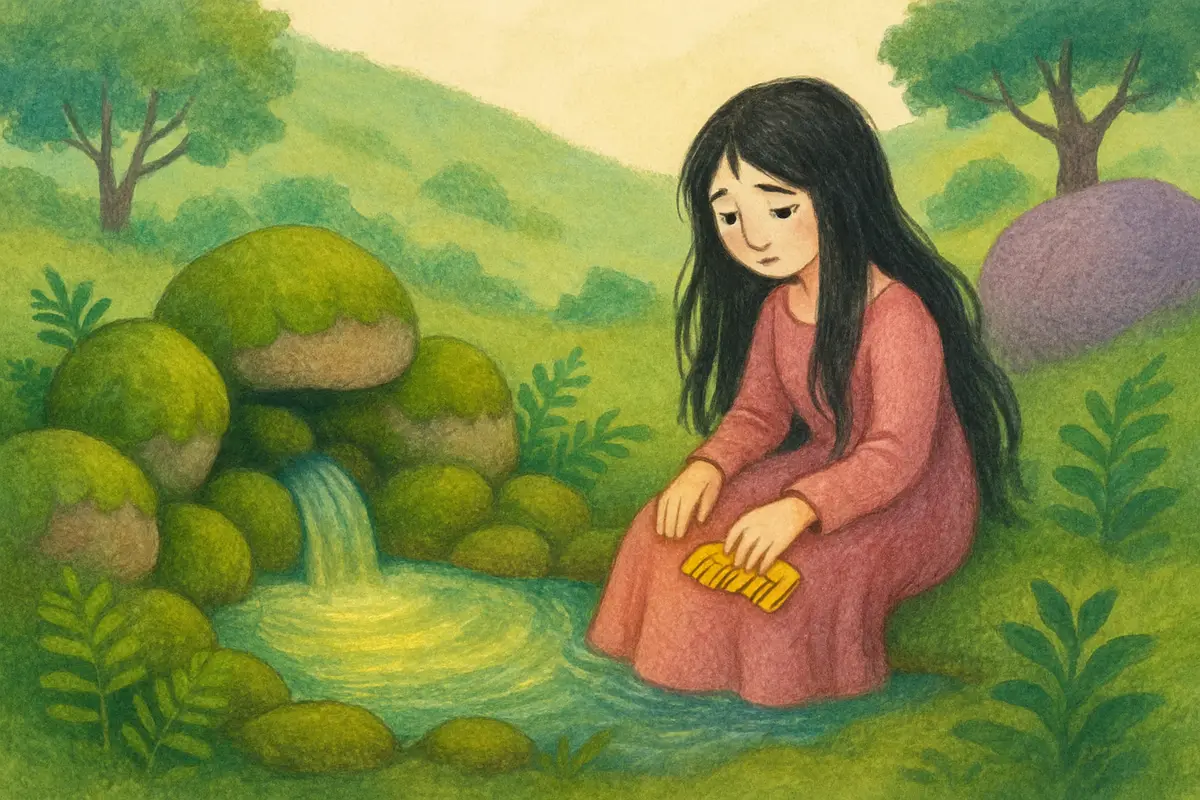
You climb until you reach a clear spring among mossy stones. Beside it sits a gentle maiden with long dark hair. This is the Moura Encantada. She looks sad and a little shy.
"My golden comb is gone," she says softly. "Without it I cannot wake the water, and the fountain in your village stays quiet. But I am too shy to go looking."
She will only talk to a calm, kind voice.
How do you put her at ease? Could you speak gently to the spring with Riversong? What kind thing could you say or do?
When the Moura trusts you, she smiles. "A shiny trail leads off into the ferns," she says. "Follow it, and please be gentle with whoever you find."
Near the top of the hills you found the spring: a clear pool ringed with mossy stones and ferns, the very heart of all the village's water. Beside it sat a serene maiden with long dark hair, her chin resting on her knees. This was the Moura Encantada, the gentle spirit of the spring, and she looked close to tears.
"My golden comb is gone," she told you, so softly you had to lean in. "It is the comb I draw through my hair to wake the water and keep it singing. Without it the spring sleeps, and your fountain down in the square stays quiet and grey. I would look for it myself, but I am too shy to leave the water, and too shy to face whoever took it."
She is wary of loud voices and grabbing hands. She will open up only to a calm, patient kindness.
How do you set the Moura at ease so she will trust you? Could Riversong let you speak softly to the spring on her behalf? What gentle words or small kindness might coax her story out?
When at last she trusted you, the Moura lifted her head and almost smiled. "There is a trail," she said, pointing to a faint glint among the ferns, "a line of shiny things, leading off down the hill. Follow it, and whatever you find at the end of it, please be gentle. Not everything that takes a shiny thing means any harm."
For the grown-up: the solution
The challenge. The Moura Encantada has lost her golden comb and is too shy to say much. She will only point the way once the players have earned her trust with calm, gentle kindness.
Intended solutions. This is a social, gentle-heart moment more than a magic trick:
- Riversong is the natural fit: speak softly to the spring, and let the water carry a kind word to the Moura.
- Bloom can soften the mood, coaxing a few flowers up at the water's edge as a small gift.
- A simple kind action with no magic at all (sitting quietly, speaking gently, promising to help) works just as well.
Fallback. If the children are unsure what to say, have the Moura ask a tiny question of her own ("Have you come from the village? Is the fountain very sad without its water?") to give them a thread to pull. Any genuine kindness opens her up and tops up an energy star.
Make it simpler. For a younger child, just have everyone say one kind thing to the Moura, or wave hello gently, and let that be enough for her to smile and point to the trail.
Stop 2: The Stepping Stones
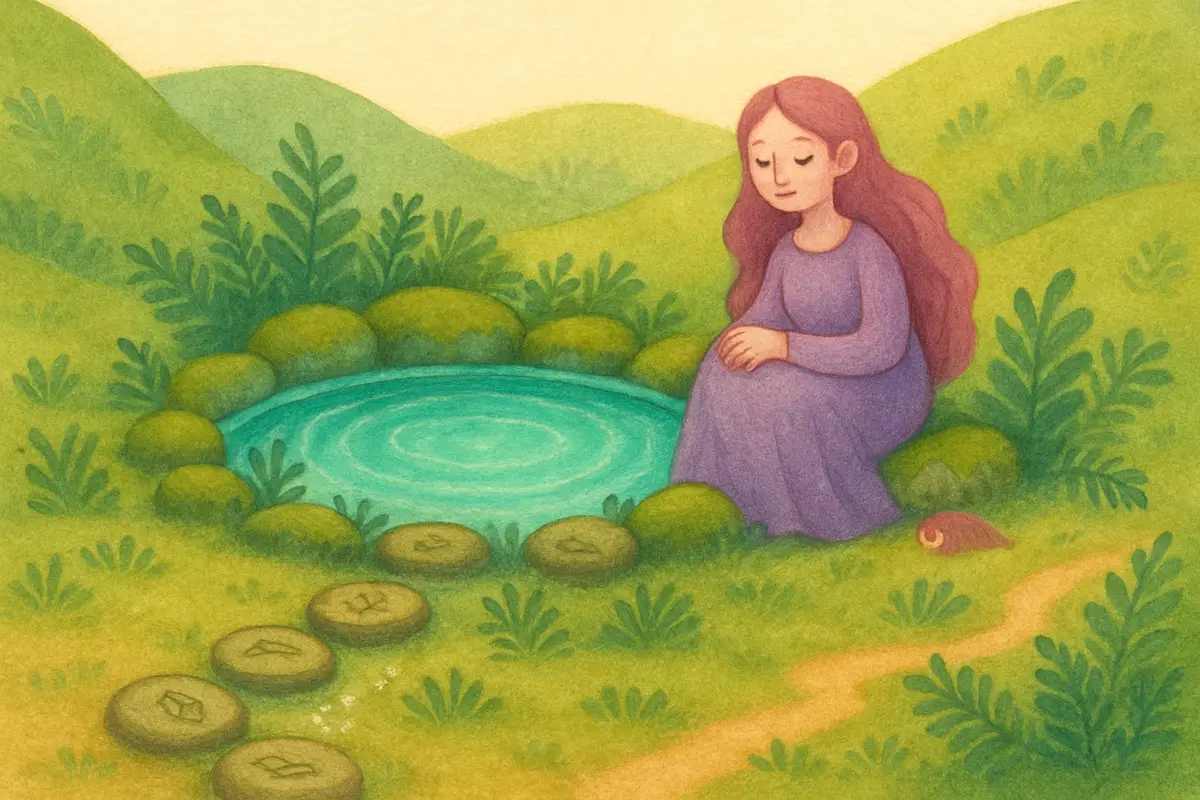
The trail leads to a shallow stream. To cross it you must step on the right stones. Each stone has a small carved mark: a leaf, a star, a wave, then a leaf, a star, and a gap where the next mark should be.
A little voice in the water hums, "Leaf, star, wave, leaf, star, and then?"
What mark comes next in the pattern? Which stone do you step on?
When you step on the wave stone, the water steadies and lets you across. On the far bank, the shiny trail leads under a little stone bridge.
The shimmering trail led you to a shallow stream, too wide to jump. The only way across was a winding line of old stepping stones, each one carved with a small worn symbol. You read them aloud as you went: a leaf, a star, a wave, then a leaf again, a star again, and then a stone whose mark had crumbled away, with deeper water on either side.
From under the surface a small watery voice hummed the same little tune over and over: "Leaf, star, wave, leaf, star, and then?"
Look at the pattern the carvings make. Which symbol must the crumbled stone be? Work out the next mark in the sequence, and that is the safe stone to step on.
The moment you chose the wave stone, the stream stilled and let you pass dry-shod. On the far bank the shiny trail gathered itself and ran on, straight under the mossy arch of a little stone bridge.
For the grown-up: the solution
The challenge. A line of carved stepping stones crosses a stream. The marks run leaf, star, wave, leaf, star, and then a crumbled stone. The players must work out which mark belongs on the missing stone and step on that one.
Solution. The pattern repeats in threes: leaf, star, wave, leaf, star, wave. So the missing mark is the wave, and the wave stone is the safe step. Logic and observation do the work here, not a magic, though Riversong can ask the stream to confirm, and Starlight can light the carvings if the day is dim.
Fallback. If the children are stuck, read the watery rhyme again slowly, tapping each stone in turn so they hear the three-beat pattern. Working it out with help still counts as a full success and tops up an energy star.
Make it simpler. For a younger child, lay out just three objects (leaf, star, wave) and then leaf, star again, and ask only "what comes next?"
Stop 3: The Trasgo's Nook
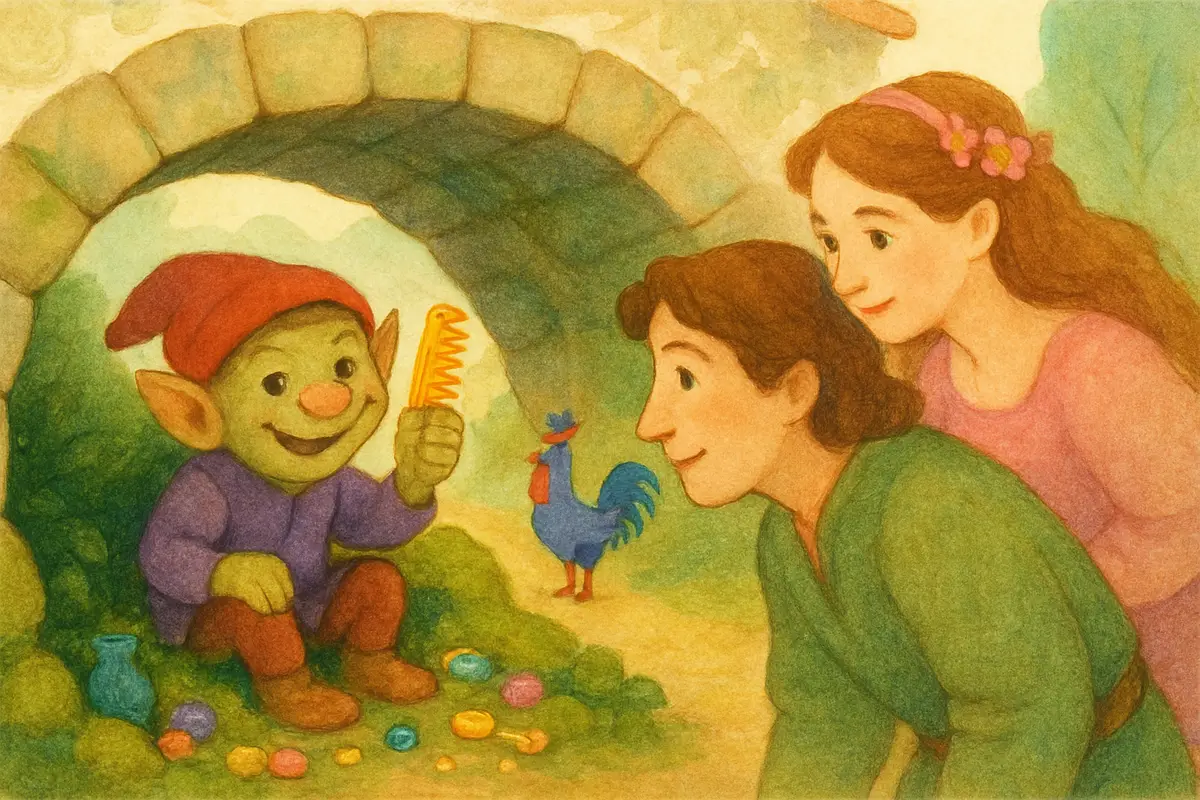
Under the bridge is a cosy nook full of bright, shiny things. In the middle sits a small goblin in a red cap, the Trasgo, playing happily with the golden comb. He grins at you.
"I found it. It is shiny. It is mine now," he says, holding it tight. He is not mean. He just loves shiny things and a good game, and he is a little lonely down here.
How do you make friends with the Trasgo? Could you offer a swap, a riddle, or a game? What would a playful goblin like?
When you trade something he loves, or win his game, the Trasgo laughs and hands over the comb. "Come and visit me again," he says. "It is quiet under here."
Beneath the bridge you found a snug, mossy nook, and it glittered. Every ledge was crowded with shiny odds and ends: a brass button, a chip of mirror, a curl of ribbon. In the middle of it all sat a small goblin in a bright red cap, the Trasgo, turning the golden comb over and over in his hands and humming to himself.
He grinned when he saw you, but his fingers tightened on the comb. "I found it fair and square. It is the shiniest thing I ever found, and it is mine now." He was not wicked, only playful and proud, and, you slowly realised, rather lonely under his quiet bridge. What he loved most in the world was a game, a riddle, or a fair swap.
How do you win the Trasgo over? He will not be scolded or grabbed, but a clever trade, a riddle, or a game he can enjoy might change his mind. What would delight a playful, lonely goblin enough to part with his treasure?
When you offered him something he loved just as much, or beat him at his own riddle, the Trasgo threw back his head and laughed and pressed the comb into your hands. "A good game," he admitted. "Come back and play sometime. It gets quiet, down here under the bridge, with nobody to swap with."
For the grown-up: the solution
The challenge. The Trasgo has the golden comb and loves it because it is shiny. He will not give it up to scolding or grabbing. He is playful and lonely, and he wants a game, a riddle, or a fair swap.
Intended solutions. This is a befriending moment:
- A fair swap. Offer him something he would love as much: a shiny carried object, a chip of mirror, a slice of rosca bread (he cannot resist its smell).
- A riddle or a game. Trade riddles, or play a quick game; win it, or simply play along generously, and he hands the comb over for the fun of it.
- Truth can gently show him the comb belongs to the Moura and the village needs it, and that a friend is better than a treasure. Bloom can brighten his lonely nook so he feels less alone. Birdsong can fill that nook with birds and song so the lonely Trasgo creeps out to listen and join in.
Fallback. If the children freeze, have the Trasgo propose the game himself ("I will trade it for a good riddle. Got one?") so there is an obvious door to walk through. The moment they make any friendly offer, let him laugh and give up the comb.
Make it simpler. For a younger child, let a single shiny swap or one shared joke be enough; the Trasgo is easily delighted.
Stop 4: The Comb Returned
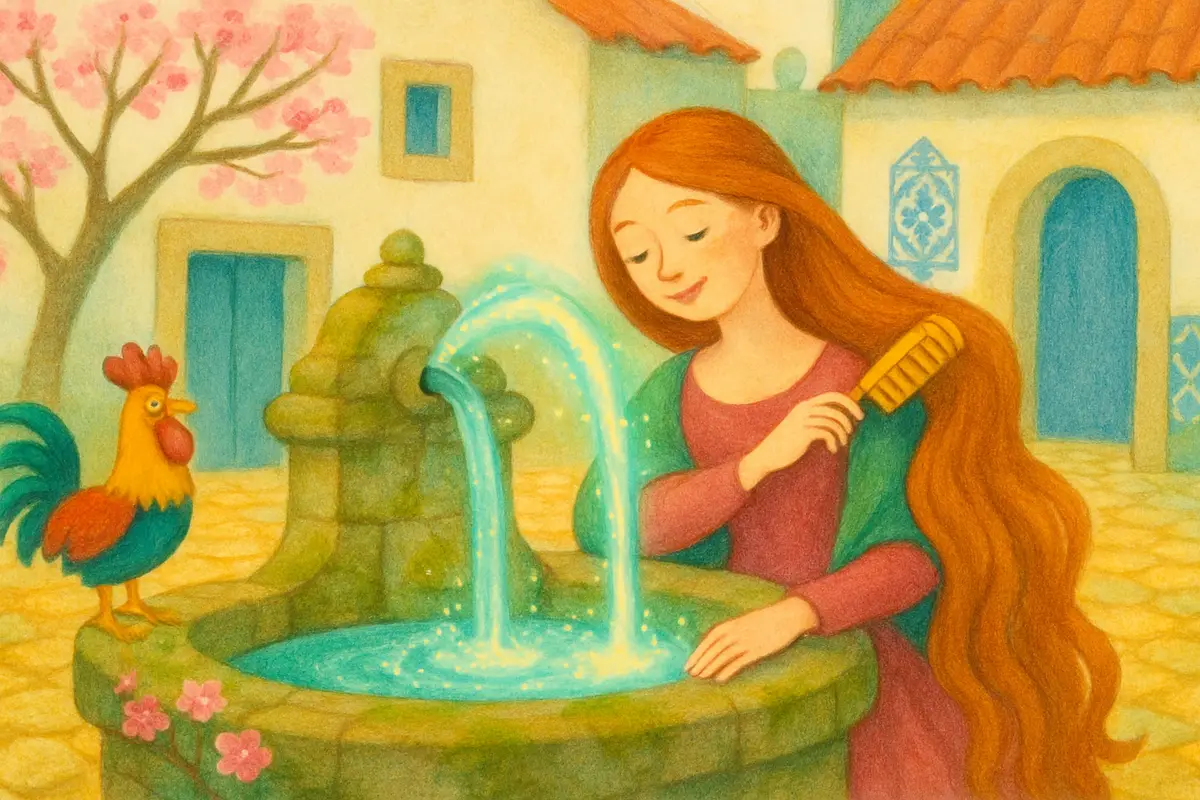
You carry the golden comb back up to the spring. The Moura Encantada is waiting. Very carefully, you place the comb in her hands.
She draws it once through her long hair. The water lights up clear and bright and lifts in a gentle, glowing arc.
How do you give the comb back kindly? What do you say to the Moura?
"Thank you," she says. "You were gentle, and you made a friend instead of an enemy. The water will sing again."
You carried the golden comb back up the hill, cradling it like a fledgling. The Moura Encantada was waiting at the water's edge, and her eyes went wide and bright when she saw what you held. You knelt and, very gently, laid the comb across her open hands.
She drew it once through her long dark hair. At the very first stroke the spring woke: the water lit clear and bright and rose in a slow, glowing arc that hung in the air like a held breath, then fell back singing.
How do you return the comb so the moment stays kind and calm? What do you say to the Moura now that her spring is hers again?
"Thank you," she said, and now she truly smiled. "You were gentle when you might have been rough, and you made a friend of the Trasgo when you might have made an enemy. That is why the water trusts you. Now go, and listen for it."
For the grown-up: the solution
The challenge. The players carry the comb back and return it to the Moura Encantada. The only "test" is to do it gently and kindly, so the moment stays warm.
Intended solution. Have the players hand the comb over with care and say something kind. There is no roll to fail here. Riversong can let them tell the spring the good news first; any gentle gesture completes it.
Fallback. If a child is shy, the Moura simply reaches out and takes the comb with thanks. The success is guaranteed; this stop is about the warm feeling, not a puzzle.
Make it simpler. For a younger child, just placing the comb in the Moura's hands and watching the water light up is the whole of it.
The Spring Sings Again
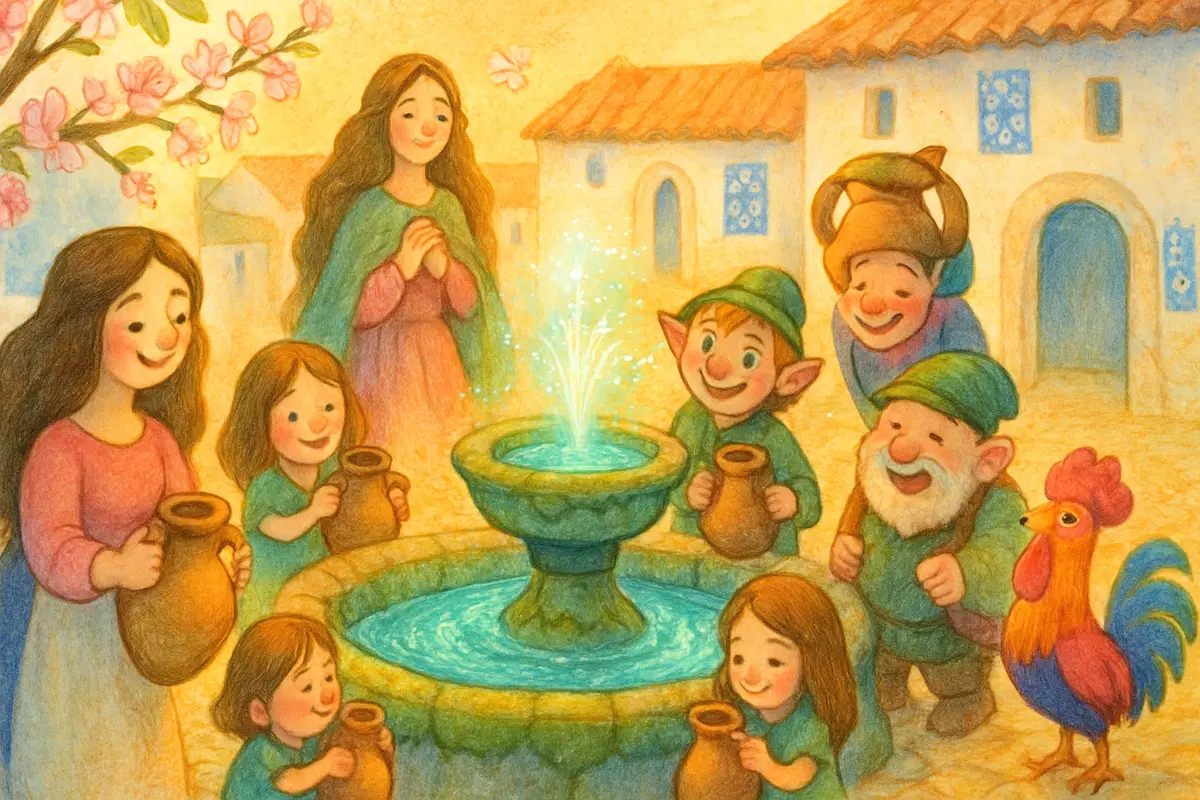
You hurry back down to the village. The Old Fountain is bubbling clear and bright, and the water almost sings. Children laugh and fill their jugs. The Moura sends a cool, sweet blessing down with the water.
You did it together. You were kind, and you were full of ideas. Well done.
You ran back down the winding path, and you heard the square before you saw it: a bright, bubbling, splashing sound, and under it something almost like a song. The Old Fountain was clear and full again, water dancing up into the sunlight while children laughed and dipped their jugs and the whole village crowded round.
Cool and sweet, the Moura's blessing came down with the water, the way it had for a hundred years and would for a hundred more.
You did it together. You were kind when it was easier to be quick, and you were full of ideas when one idea was not enough. Well done.
For the grown-up: the solution
This is the resolution, not a puzzle, so there is no band and no roll. The Moura draws the comb through her hair, the spring wakes, and down in the square the Old Fountain runs clear and sings again. Let the children feel the whole village's relief and the Moura's cool, sweet blessing. They won by being gentle with a shy spirit and making a friend of the Trasgo instead of an enemy, which is the only way anyone wins among the Enchanted Springs.
Here nobody loses. If a try does not work, you just find another way.
Read aloud together, pause often, and try ideas. There are no wrong answers.